

Downfall for rich state atop economic rankings
Western Australian powerful resources sector has kept it at the top of the country’s economic pecking order for decades but now the crown is slipping, a report has shown.
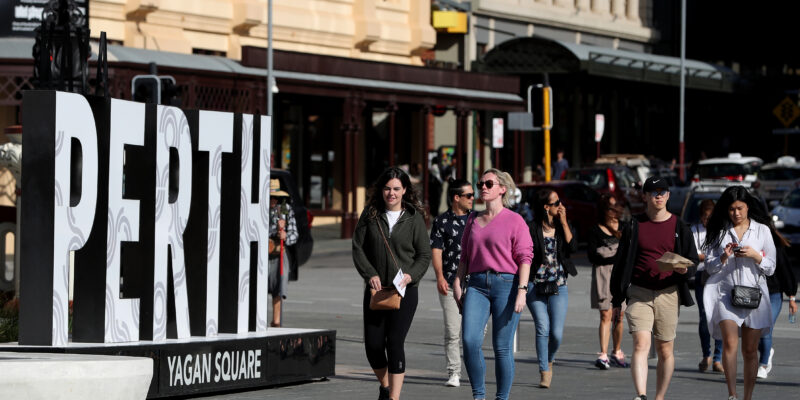
QUEENSLAND has usurped Western Australia at the top of Australia’s state economic rankings, as cracks emerge in the resource-rich state’s performance.
WA slid two places to third in CommBank’s revamped State of the States rankings for the June quarter, after holding top spot in four of the past six quarters.
While the state’s economy was still strong, coming in second for household consumption and third for dwelling investment, WA’s aggregate performance was being propped up by strong migration levels.
On a per capita basis, consumption fell 0.1 per cent over the year, the worst of any state except for Victoria.
Cost pressures had been weighing on West Australian households, report author Harry Ottley said.
“Since (the fourth quarter) 2019, Perth has recorded the highest annualised inflation of any capital city, on both headline CPI and housing, while Perth dwelling prices have more than doubled – the largest increase nationally,” he said in the report.
WA’s loss was Queensland’s gain, with the Sunshine State taking top spot off the bank of strong business and dwelling investment.
“Queensland’s expansion has changed engine,” Mr Ottley said.
“Through 2025 the consumer did much of the work – consumption growth peaked at 3.3 per cent annually in Q1 2026 – but it is now investment providing support.”
The strength in the broader Queensland economy came despite a weakening in the state’s public finances, with the Crisafulli government copping the first cut to its credit rating with S&P Global in 17 years because of growing deficit and debt.
South Australia was the quarter’s big improver, jumping two spots to second, while NSW slipped from third to fourth.
Victoria held onto sixth spot, with its unemployment rate among the country’s highest and household consumption among the weakest.
The ACT was in fifth, while the Northern Territory and Tasmania came seventh and eighth, respectively.
Despite Victoria’s overall softness, it was ranked third for business investment as data centre construction drove a 22 per cent jump in new building over the year.
Victoria claimed a sizeable 22.8 per cent of Australia’s 6GW data centre pipeline, but was dwarfed by NSW, which is home to 50.7 per cent of planned data centre capacity.
Despite topping the overall economic rankings, Queensland only claimed three per cent of the data centre pipeline, with only the ACT having a smaller share.
“Data centres are becoming an increasingly important part of the investment story, particularly in NSW and Victoria,” Mr Ottley said.
“The June quarter showed that activity is shifting from equipment and fit-out towards construction, while interest is also spreading beyond the two largest states.”