
Labour pains: jobs market too hot for inflation fight
Australia's labour market is still tight, and the unemployment rate likely needs to go up to ease persistent pressure on inflation, Michele Bullock says.
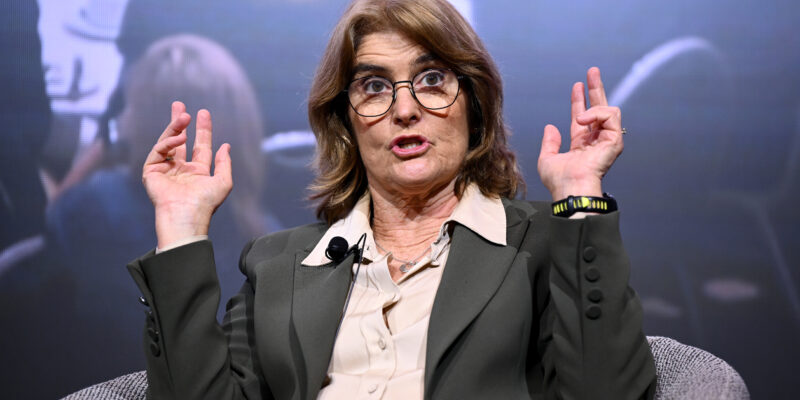
AUSTRALIA’S unemployment rate probably needs to edge a little higher to help get inflation back under control, Reserve Bank governor Michele Bullock says.
Prefacing her remarks by saying the RBA does not want to see high unemployment, Ms Bullock told a business event on Tuesday that the labour market was still a bit tight and inflation was too high.
The 4.5 per cent jobless rate is at the lower limit of what the RBA thinks will bring down inflation to an acceptable level, Ms Bullock said.
“There are certain levels of unemployment that if you go below that level of unemployment, it introduces a lot of pressure in the labour market, and that can put upward pressure on wages and prices,” she said.
“It puts pressure on costs for businesses, that finds its way into prices.
“Between 4.5 and 5 (per cent) will probably take enough heat out of the labour market that it’ll ease pressure on inflation.”
Money markets and economists at all four big banks already expect the central bank to hike interest rates in September for a fourth time in 2026, following hawkish comments in recent weeks by Ms Bullock and other top RBA officials.
Labour force figures for August, due to be released by the Australian Bureau of Statistics on Thursday, are expected to show the unemployment rate holding steady at 4.5 per cent.
Ms Bullock’s comments at the Committee for Economic Development of Australia event show the unemployment data likely won’t deter the RBA from raising rates.
As she told a parliamentary committee on Friday, Australia’s productivity malaise means even relatively subdued economic growth is pushing inflation up above the bank’s 2-3 per cent target band.
Governments can help to boost productivity by removing red tape or boosting competition, for example, but businesses had to step up to the plate as well, she said on Tuesday.
“Australian businesses just seem to have become less dynamic, and even those businesses that are sort of at the frontier, or were at the frontier, are not quite as close to the frontier as they used to be,” Ms Bullock said.
Productivity has only grown at an average of 0.3 per cent per year over the past decade but the three-yearly Intergenerational Report, released by Treasurer Jim Chalmers on Monday, assumed that productivity growth would return to 1.2 per cent within five years.
While some economists viewed the assumption as overly optimistic, Ms Bullock said she saw it as a call to action to revive productivity growth.
“That’s what we’ve got to aim at if we want to maintain good outcomes for the Australian economy,” she said.
Dr Chalmers denied that the government was putting all its eggs in the AI basket.
“AI will be an important part of (boosting productivity), but not the only part of that,” he told Nine’s Today Show on Tuesday.
“The budget actually had the biggest and broadest productivity package of any budget in decades to try and get approvals faster, to try and attract more investment, to work with the states more effectively.”
Making it easier for nurses, electricians and other workers to work across state borders by harmonising licensing requirements would be a big help for productivity, Ms Bullock said.
But AI was the “great white hope”, although it was yet to show any evidence that it was helping.
“When I talk to colleagues around the world about this, I think everyone thinks that. But I think everyone also agrees that there are very few signs, yet that AI is actually influencing the supply side of the economy,” Ms Bullock said.
“There’s lots of evidence that it’s influencing the demand side of the economy.
“So, we’ve got this sort of awkward sequencing event at the moment, where in Australia at least we are in a situation of excess demand, and the AI boom is adding to that demand ahead of any potential supply impacts that it might have gone forward.”