
Australian developers have their heads in the clouds
With prime land lots expensive and hard to secure, big residential building developers are reaching for the sky in big projects. Skylines are changing and Queensland’s Gold Coast is leading the way.
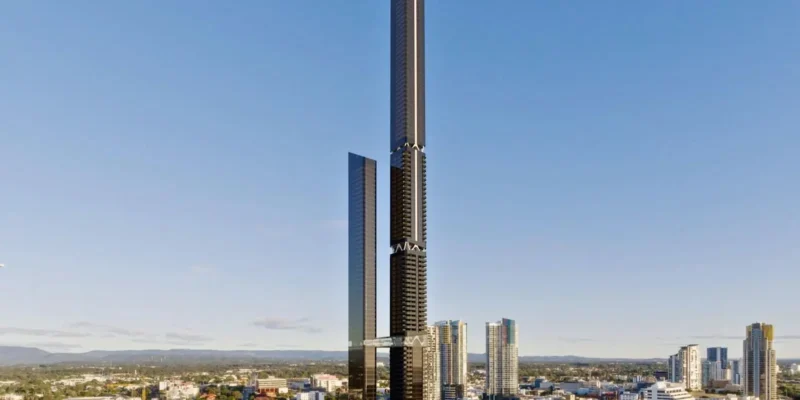
AUSTRALIA has its share of tall buildings, but the skyline is set for a shakeup, with a newly approved Gold Coast super tower set to eclipse them all.
Once built, Gold Coast tower One Park Lane will feature two slender towers: a 101-storey and a 60-storey tower, with the higher tower soaring 393 metres into the sky.
The landmark building will tower over Australia’s current tallest building, the nearby Q1 in Surfers Paradise, at 323 metres high.
The shifting urban landscape is unsurprising given efforts to increase housing supply amid a growing population.
The government wants 1.2 million new homes built by mid-2029, while the population is growing by 1.6 per cent annually, or about 423,400 people, according to the Australian Bureau of Statistics.
Skyscrapers are already commonplace in densely populated cities, and currently, Dubai tops the list with the world’s tallest building, Burj Khalifa, a residential, office, and hotel tower soaring 828 metres.
But it may not be for long: the construction of Saudi Arabia’s Jeddah Tower is set to break the 1000-metre threshold. This “height seemed only to exist in fantasy just years ago,” according to the Council on Tall Buildings and Urban Habitat.
In Australia, builders of tall towers must adhere to strict governance requirements, which differ from state to state.
Under the national rules, the building and design must comply with Australia’s building code as well as aviation safety rules – tall structures, including cranes and buildings, can affect flight paths.
At a state level, builders need to check zoning restrictions and height limits in the local planning scheme, hire specialists early on, and obtain the required technical reports.
In NSW, projects of state significance, such as tall buildings, are often overseen by the State Design Review Panel, which provides independent design quality advice.
In Victoria, local planning schemes and urban design guidelines guide the development of taller buildings, considering issues such as building separation, street setbacks, height, overshadowing, and wind controls.
Meanwhile, in Queensland, local governments set height limits, and for some precincts, state rules apply.
Australia’s capital cities are among the least dense for their size in the world, according to the Grattan Institute, which, in a new report last month, called for three-storey townhouses and apartments to be allowed on all residential land in all capital cities to tackle the housing crisis.
The think tank also wants six-storey or higher housing developments allowed as-of-right around major transit hubs and key commercial centres, arguing these reforms could lift housing construction across Australia by up to 67,000 homes a year.
AUSTRALIA’S TALLEST BUILDINGS
- Q1 Tower, Gold Coast, 323 metres
- Australia 108, Melbourne, 317 metres
- Eureka Tower, Melbourne, 297 metres
- One Barangaroo, Sydney, 271 metres
- Aurora Melbourne Central, Melbourne, 271 metres
- Brisbane Skytower, Brisbane, 270 metres
- West Side Place Tower A, Melbourne, 269 metres
- 120 Collins Street, Melbourne, 267 metres
- Ocean, Gold Coast, 265 metres
- The One, Brisbane, 262 metres
Source: Council on Tall Buildings and Urban Habitat