Australia’s fiscal metrics ‘broadly weaker’ than peers
A top rating agency has reiterated its confidence in Australia's ability to pay its bills, while hinting at potential longer-term issues with its NDIS spending.
AUSTRALIA’S fiscal profile remains broadly weaker compared to its AAA-rated country peers, but the outlook raises few concerns, a major ratings agency says.
Fitch Ratings, one of the big three alongside Standard & Poor’s and Moody’s, pointed to the Labor government’s higher debt and deficits compared to some other top-tier European countries facing higher defence spending.
“Things still look relatively stable in line with our outlook,” the agency’s sovereign ratings senior director, Jeremy Zook told a briefing in Sydney on Monday.
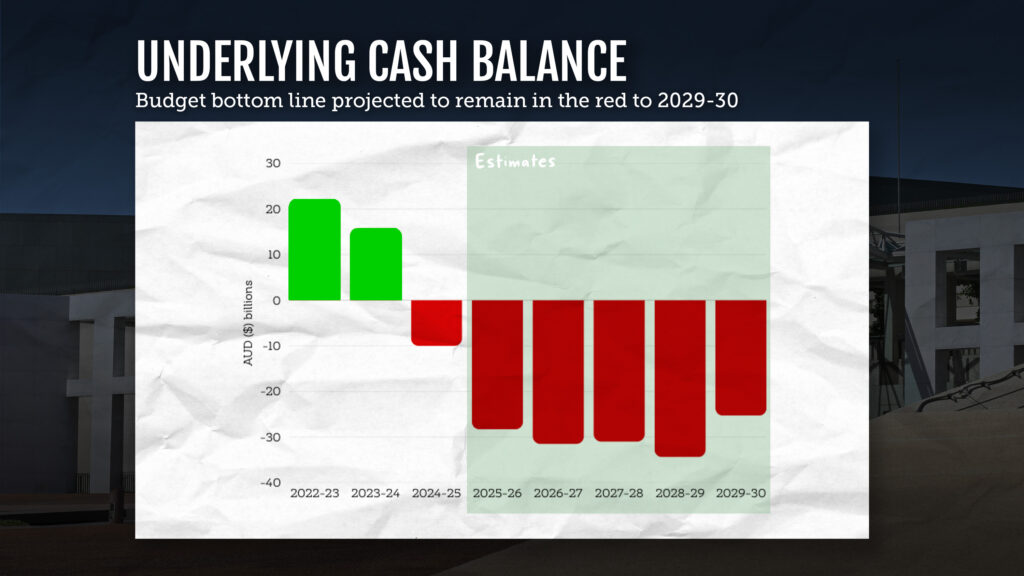
The federal government deficit is forecast to rise to $31.5 billion in the new financial year, with net debt at $616.6 billion, and the fiscal bottom line projected to remain in the red until 2034/35.
Fitch, which is due to release its annual review of Australia’s credit rating later this year, says the nation’s debt-to-gross domestic product ratio is about 10 percentage points above the AAA country median.
Australia’s ratio, which reflects a country’s ability to pay back its borrowings, is about 19 per cent.
“The deficits are about twice the level of the median as well,” Mr Zook said.
“A picture where the debt ratio kind of remains on a stable path going forward, which would be comparable with the deficit slightly below where we are at the moment, would certainly keep the AAA intact.
“The positive for Australia is really on the growth side – we have about two per cent over the medium term, and that’s quite a bit stronger than a low of these European sovereigns as well, so that helps out on the fiscal side.”
Private sector investment – excluding that already evident in data centres for artificial intelligence technology – is also expected to hold up relatively well over the medium term, even if consumer spending dips.
But productivity output remains a challenge for Australia and may depend on the federal government offering policy certainty to the business sector.
The most important ratings sensitivity for Fitch remains on the fiscal side, and whether there is a sustained or “pretty significant” rise in debt in Australia, Mr Zook said.
At the same time, one of the federal budget’s highest costs outside of defence spending is the National Disability Insurance Scheme, which is currently running at about $56 billion a year.
The government has pledged to cut the cost by $37.8 billion over five years.
“The government has taken some steps, of course, to try to rein in the increasing costs there, but we think that there could still be some challenges over the longer term,” Mr Zook said.
“Structurally, there could be some pressures that arise.”