
Australian economy builds as investment roars back
Australia's economic growth rate came in below market expectations, but a strong domestic pulse shows the economy is in good shape.
SURGING investment in data centres and housing has driven Australia’s economic growth rate to its fastest pace in two years.
The nation’s gross domestic product grew by 2.1 per cent over the year to September, the Australian Bureau of Statistics reported on Wednesday.
The increase was lower than expected by economists, who had pencilled in a rise of 2.2 per cent over the year.
But ongoing strength in consumer spending and business investment revealed a strong economic pulse.
GDP expanded by 0.4 per cent over the quarter, which was down from the upwardly-revised 0.7 per cent rise the previous month.
But the drop was largely down to businesses drawing down inventory stockpiles to meet demand for exports as well as a rise in imports.
Excluding those, domestic demand surged by 1.2 per cent over the three months, Oxford Economics Australia analyst Harry Murphy Cruise said.
The annual growth rate was the fastest since September 2023 and exceeded the two per cent rise predicted by the Reserve Bank of Australia in its November economic forecast.
Household consumption rose 0.5 per cent and would have been higher if not for smokers shifting from legal to illicit tobacco.
The data confirmed the economy was in good shape, Mr Murphy Cruise said.
“Slightly too good, in fact, for the RBA,” he said.
“With inflation rising and domestic momentum building, the central bank has its work cut out for it.
“Rate cuts are off the table for some time and a hike next week to nip inflation in the bud can’t be ruled out.”
The challenge for the RBA was that the economy’s speed limit was being constrained by a lack of productivity, head of Deloitte Access Economics Pradeep Philip said.
“The only way out of this conundrum is a concerted effort to lift the supply capacity of the economy and to drive productivity-enhancing economic reform,” he said.
Labour productivity rose 0.2 per cent over the quarter, but unit labour costs – a key contributor to inflation that is closely monitored by the RBA – still climbed 4.9 per cent in the year to September.
The private sector continued to take over from the public sector as the driver of economic growth.
Machinery and equipment investment was up 7.6 per cent, reflecting ongoing expansion of data centres, ABS head of National Accounts Grace Kim said.
“This is likely due to firms looking to support growth in artificial intelligence and cloud computing capabilities.”
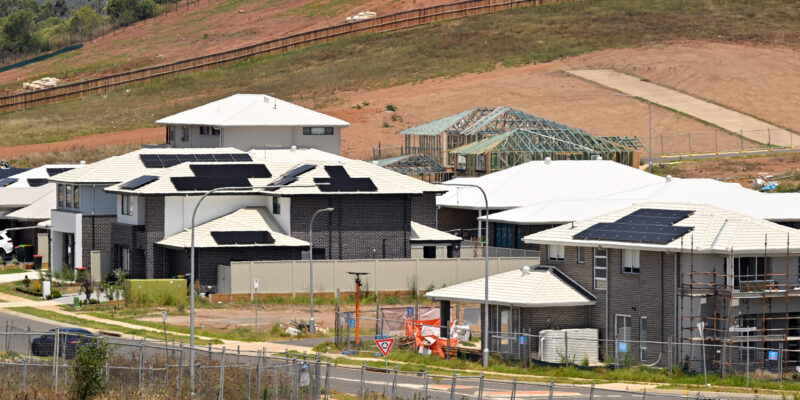
Investors piling back into the housing market following three RBA rate cuts boosted construction and real estate activity.
The strong growth in business and housing investment was the biggest story in the data, Treasurer Jim Chalmers said.
“This is a positive and promising result and shows we’ve made a lot of progress together in our economy,” he said.
Government spending bounced back, thanks to renewable energy and water infrastructure.
Public investment increased by three per cent in the September quarter after falling 3.5 per cent the prior three months.
The rebound in public demand prompted the opposition to blame the government for driving inflation.
Shadow treasurer Ted O’Brien said the Albanese government’s “spending spree” was driving up prices.
On a per capita basis, economic growth was flat over the quarter, with the population growing at 0.4 per cent.
The Organisation for Economic Co-operation and Development upgraded its forecast for Australia’s economy, predicting GDP to grow at 2.3 per cent in 2026 and 2027.