
Higher for longer: why low rates are relics of the past
There's growing evidence that interest rates are becoming less effective at slowing demand, meaning central banks must lift rates further to ease inflation.

MORTGAGE holders can expect interest rates to stay higher for longer, whether the Reserve Bank raises them again on Melbourne Cup Day.
The RBA has been warning that the intense competition for global capital among artificial intelligence and data centre companies is pushing up its estimate of how high interest rates need to go to keep inflation sustainably low – otherwise known as the neutral interest rate.
Christopher Kent, the central bank’s assistant governor for financial markets, said on Monday that there was reasonable evidence that neutral rates were rising both in Australia and abroad.
That could partly explain why global growth has been stronger than expected, despite the effects of the Middle East conflict and rising interest rates across the world, Dr Kent told Commonwealth Bank’s Global Markets Conference in Sydney.
For borrowers, that means interest rates will likely remain higher than previously expected if the RBA is determined to bring inflation down.

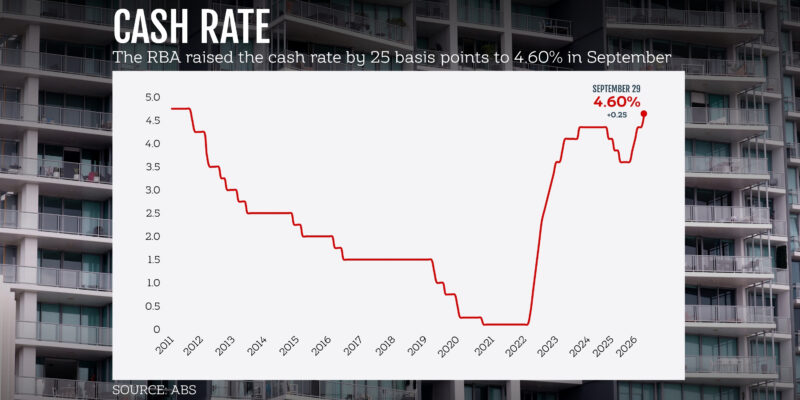
At 4.6 per cent, the cash rate is the highest it’s been in 15 years, following a prolonged period of relatively subdued inflation and low estimates of the neutral rate.
While markets have walked back expectations for another hike in November, another rate rise by mid-2027 is still almost fully priced in.
Importantly, markets do not anticipate rates to fall below current levels by at least mid-2028.
That would imply the longest period of a cash rate above 4.5 per cent since before the global financial crisis of the late-2000s.
On the other hand, the term premium – the difference in the yield an investor gets for buying long-term over short-term debt – has climbed to a 12-year high.
That could be helping to make financial conditions tighter for any given level of cash rate, Dr Kent said.
But other structural factors appeared to be weighing on the effectiveness of interest rates.
Higher spending, both from governments and AI companies, mean interest rates are less effective at bringing down demand in the economy, said Commonwealth Bank chief economist Luke Yeaman in a research note.
That meant the RBA’s “blunt instrument” of interest rates had to hit households harder to bring down aggregate demand in the economy.
As the RBA tightens monetary policy to slow spending, there was a risk that the governments could worsen the situation by turning up the fiscal taps and spending more money to shield households from cost-of-living pressures, Mr Yeaman said.
“In our view, that would be a serious mistake,” he said.
“The RBA has been very clear that it has one main job – to get inflation back to target. It has also shown that it is committed to achieving this, even if it carries economic pain.
“If the government puts its foot on the fiscal accelerator, the RBA will just push harder on the interest rate brakes.”
Federal government spending hit 26.9 per cent of gross domestic product in the 2025/26 financial year, which was the highest level in 40 years, excluding COVID-19.
HSBC chief economist Paul Bloxham said federal and state governments needed to better co-ordinate with the central bank.
“While inflation-fighting is primarily the RBA’s objective, the central bank only has a blunt instrument (a sledgehammer) to achieve it. Fiscal policy settings can be much more targeted (a scalpel),” he said.
He urged the federal government to cut spending further in its upcoming mid-year fiscal update, expected to be released in December, following recently announced measures to slow the growth in the NDIS.
“Other areas could be seeking to curtail ‘off budget’ spending, various subsidies or tax breaks, constraining public consumption (e.g. via labour demand and wages growth in the public sector), and rule out extending expiring programs,” Mr Bloxham said.
Treasurer Jim Chalmers has flagged further savings measures in the December update, but the government is already facing resistance as it tries to pass previously announced savings measures – like a reduction in private health insurance rebates for over-65s – in parliament.