
How treasurer can take heat off RBA in his next budget
Australia's banking chief will hope Jim Chalmers does two things to help the Reserve Bank in its fight against inflation when he brings down the federal budget.
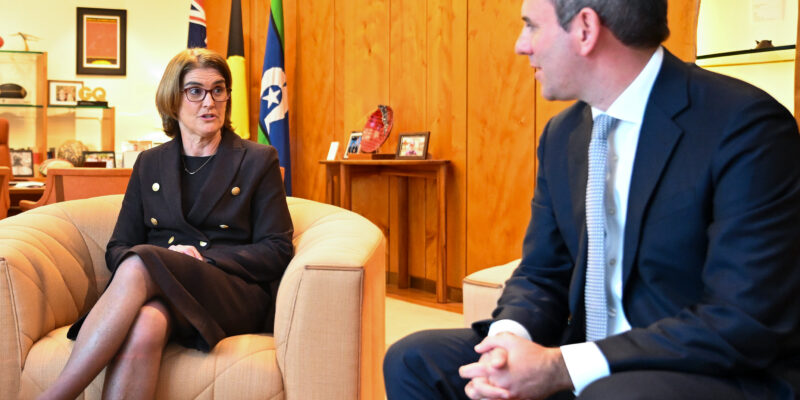
TREASURER Jim Chalmers is being urged to give Reserve Bank governor Michele Bullock a hand in her fight against inflation by cutting spending and introducing productivity-boosting reforms in the upcoming federal budget.
The RBA was forced to hike interest rates on Tuesday to get inflation under control, just six months after its last cut.
Ms Bullock was careful not to shift the blame onto the government, but she hopes Dr Chalmers will do two things in the May budget to help her out.
Essentially, the RBA’s drastic volte-face was driven by the economy’s speed limit being constrained by low productivity growth, and by high government spending acting as a turbocharger, burning up more fuel.
After three rate cuts in 2025, household spending, business investment and home building roared back much faster than the central bank anticipated.
With private demand growing and government spending still strong at 26.9 per cent of GDP, the economy’s engine is redlining despite barely pushing down on the accelerator.
Inflation is moving further from the RBA’s target despite modest GDP growth of only 2.3 per cent per year.
The most immediate thing the government could do to tackle inflation was cut spending to give the private sector more room to grow, AMP chief economist Shane Oliver said.
Otherwise, the RBA will be forced to hike rates again to get inflation down.
“Then you will wind back private demand, and that could have negative consequences,” he told AAP.
That’s easier said than done, with the government facing stiff opposition to constrain growth in the NDIS, an ageing population overloading health and aged care services, growing pressure to raise defence spending, and the rising cost of servicing almost $1 trillion in debt.
Programs such as the NDIS and childcare subsidies are popular among voters but also spray money in a non-targeted manner.
Reducing reliance on these ‘in-kind’ payments and increasing means-testing should be a priority, Dr Oliver said.
The government has made moves to get spending under control, like lowering the NDIS growth target from eight to six per cent per year.
But it needed to look holistically across the budget and determine whether every dollar was spent as efficiently as possible, said Deloitte Access Economics partner Stephen Smith.
The second part of the equation is increasing the supply capacity of the economy.
“What the government can do there is policy reform to help to boost productivity, to boost investment, and improve the run rate that the economy can grow at,” Mr Smith said.
Cutting public spending would help boost productivity by leaving more resources for the private sector, which was more efficient, Dr Oliver said.
But tax reform is also vital in the long term.
Shifting the tax burden from income towards goods and services would boost incentives to work and invest, while also reducing intergenerational inequity, Dr Oliver said.
Reducing the capital gains tax discount on investment property, as Dr Chalmers was reportedly considering under pressure from the Greens, unions and economists, would also help, he said.
Mr Smith said it was a worthwhile reform but would have little impact on productivity.
“Really, we need a broader basket of reforms, related to company tax investment allowances in particular, and other things like reducing personal income tax, to improve incentives around work and reward for people’s work as well,” he said.
However, he said the Productivity Commission’s recommendation of a new cashflow tax to encourage capital expenditure was not the right idea as it would add too much complexity and worsen businesses’ administrative burden.