
Green fields: AIC president’s link to the land
Tasmania’s rural heritage runs deep through Devonport conveyancer Debbie Hutton’s life story.
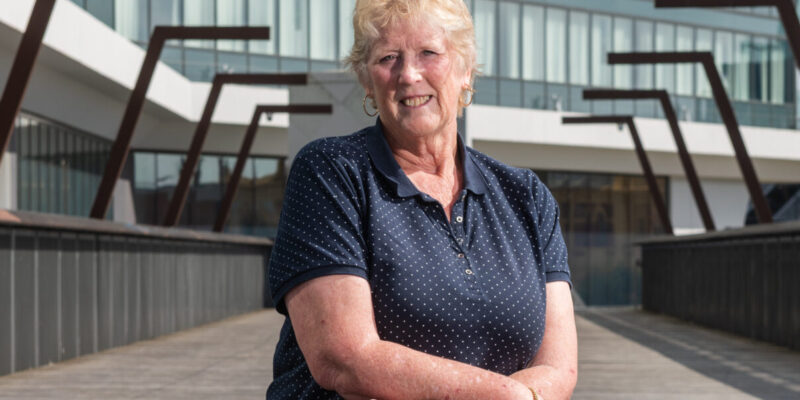
AS a girl growing up on the family farm, she regularly rode her horse Gypsy 12km to the shops – just for a milkshake.
That was in Wynyard, a town of around 6,000 souls on the north coast about 17km west of Burnie.
Her parents had a dairy property that remained in the family for 54 years, milking cows, morning and night.
“My father taught me to nail a roof on a barn, same as he did my brother,” she says.
Practical folk. Traits she applies to her firm, Debbie Hutton Conveyancing.
And since late last year, she has taken on the role of President of the AIC Tasmania, following several years as secretary.
The conveyancing business has been going for some 15 years, and with 13 employees, is among Tasmania’s biggest.
But she came to that success in a roundabout way.
“When I was a teenager, you left school, did a couple of years’ work, then wandered off to the mainland, because there were more opportunities there,” Debbie says.
She crossed the Strait at 19, on a working holiday that stretched to 24 years.
Debbie took jobs as a legal secretary/paralegal in Sydney and in Victoria, gaining her Advanced Diploma of Conveyancing part-time at NSW TAFE.
“I worked in Bankstown, lived in Granville, took the train into Ultimo TAFE after work, two or three nights a week.”
She moved home in 2009 to find the Apple Isle in a regional employment slump.
Her partner urged her to “hang out my own shingle” and go into business.
“It was quite frightening at the time,” she says, “But it’s worked.”
One advantage over the competition was online advertising, a novelty in Tasmania at the time.
Tassie houses now sit at a median of about $700,000 in Hobart, $520,000 in Devonport.
Compared to East Coast capitals, those are bargains which have seen an influx of mainlanders, plus locals moving or downsizing.
And, says Debbie, buyers are generally better informed about values and regulations than was usual five or 10 years ago.
That can be a problem for vendors. Tasmanians have been resourceful for 200 years with the “do-it-yourself build or renovation” quite common, particularly in country areas where DIYers didn’t necessarily worry about building codes.
Now, those savvy buyers are demanding certificates.
“I’ve had clients who’ve had to go back and fix things up to code,” says Debbie, “and it’s been quite expensive for them.”
She believes this complex issue requires further investigation on how to protect the consumer – both outgoing and incoming – particularly with the current direction the Building Code is taking.
It’s also been challenging for conveyancers as Tasmania upgrades from paper-based systems.
The past couple of years have brought ARNECC, PEXA, changes to FIRB and FRCGW, and next, AML/CTF.
“We’ve had all these things come to us one after another,” says Debbie. “Like a train where every carriage has something different in it.”
VOI or KYC? “But you’ve known us all your life,” smalltown customers might complain. “We went to school together!”
Although she’s seen no evidence of money-laundering in her area, Debbie is on AUSTRAC’s working group and appreciates the need for vigilance.
She has also adjusted her fee structure to take into consideration the additional workload.
“There’s a lot of compliance work, and unfortunately I need to pay my staff and myself to do that.”
Debbie’s parents, now in their 80s, sold the farm a couple of years ago and moved into town.
She’s considered easing up, too. “I don’t know that I could retire fulltime… but maybe spend another day in my garden.”
Or saddle up and mosey into town for a milkshake.