

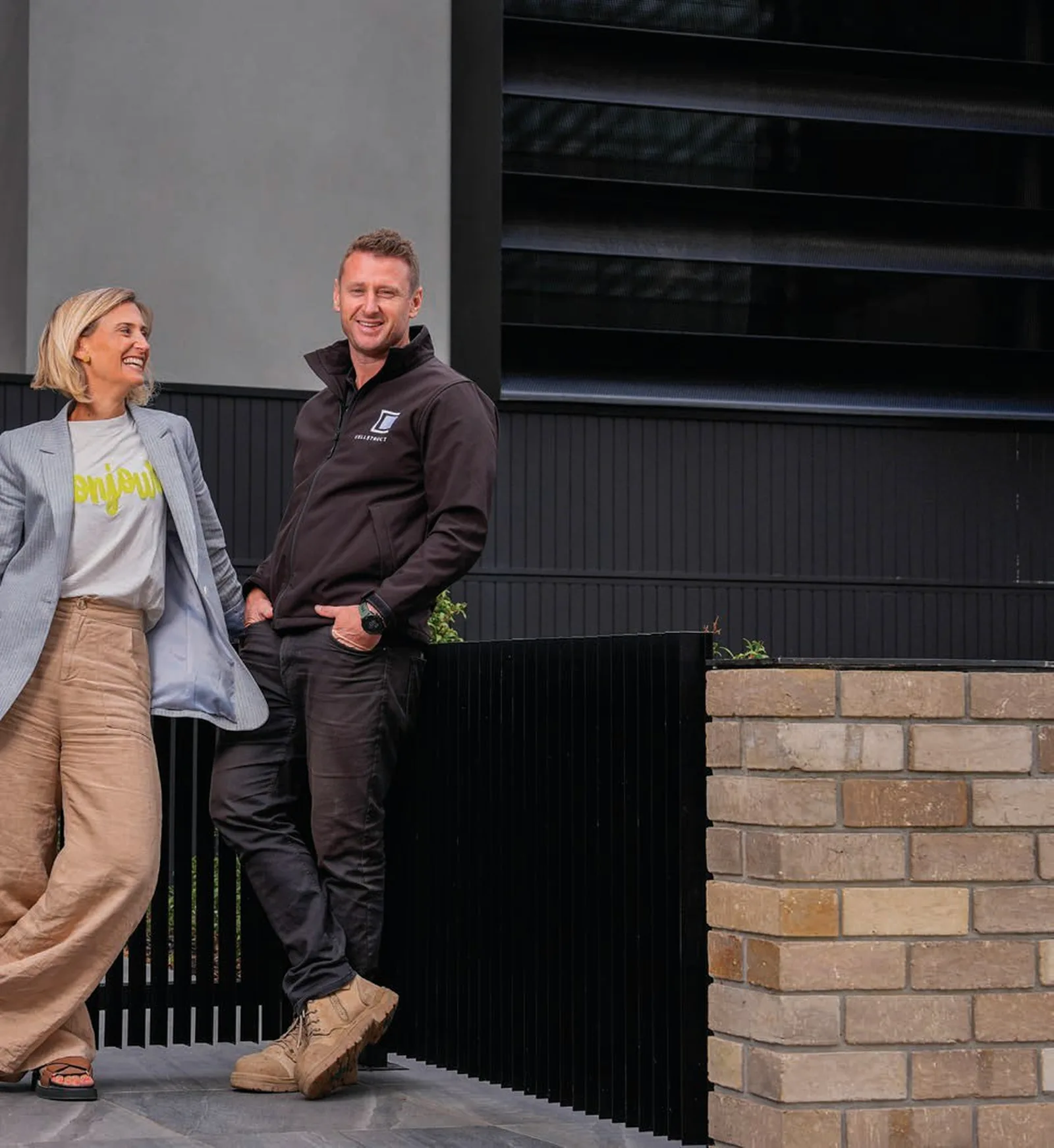
Ten years ago, building company owners Emily and Mark Ainley could foresee a boom market emerging for dual-occupancy developments in their Melbourne Bayside community.
And they wanted in on the ground floor from both a business and a family perspective.
“The way that we got into the Bayside area ourselves was we bought a big block, subdivided it, put two houses up, kept one and sold one,” said Emily, who works alongside Mark at Cellstruct, their second-generation family-owned building company.
“That strategy made it a much more affordable process for a young family to enter the Bayside market.”
After completing a few more successful dual-occupancy builds for themselves, the couple could foresee there was going to be a “real boom” in duplex and townhome construction in their area because of the number of rundown houses on big blocks with premium land values.
They decided to switch their company focus away from industrial commercial building work to specialise in dual-occupancy dwellings.
“We got the word out there amongst local architects and the local real estate agents who might be selling these blocks and dealing with developers,” Emily said.
“And that was how we became specialists in this space.”
Now, with five personal dual-occupancy builds under their tool belts, the Ainleys are also managing between four and six projects for their clients at any one time, with 80 per cent of their work dual occupancy.
The Cellstruct team of 10 offer their clients a bespoke, fixed-price service, including budgeting, permitting, designing and sub-division, charging a management fee for the turnkey results.
“A lot of our clients have no idea how to go about the process so they come to us,” Emily said.
“We help them engage one of our preferred designers and work with them depending on budgets.”
In the past 10 years, Emily said she has noticed developers moving away from the dual-occupancy space and now most of their clients are established homeowners, who have lived in the Melbourne Bayside area for many years. “The area used to be very much a developer market,” she said.
“But the expectation of homeowners and the value of their land in our area have gone too high. And then combine that with the increased costs of construction and the developers can’t make it add up anymore.
“There are just not the margins in there at the end for a developer to take any interest.
“So now the client that is looking to develop dual-occupancy dwellings is very much the homeowner, who has generally lived in the area for a long time.
“They’ve got their community, they know the area, they’re comfortable and they typically don’t owe a lot on the land anymore.
“They know that they need to do their house up or renovate it or fix it. And they’re generally at a later stage of life, empty nesters, who don’t need so much room.
“They also don’t really want to have a mortgage. So they borrow for the dual- occupancy construction. They get a new home. They sell the other one and that pays off their construction.
“And, depending on the size of their mortgage, they might pay that off, too.”
By Leigh Reinhold
§ DIARY OF A DYNAMIC DUO
Do your sums and make sure it’s worth the effort: After completing four dual-occupancy projects and a three-home build, one couple offer their advice
Mum and dad property developers Susan and Greg Davis* started their dual-occupancy journey 25 years ago when they bought a rundown house on a big block in the Melbourne suburb of Hampton with plans to subdivide.
“It was our only option to get into the market at the time,” Susan said.
“It was hard. Coming from New Zealand, we had a small budget and it was a pretty horrible house, but it was on a 1000 square metre block, so we decided, OK, we can subdivide at some point.”
The couple also saw the project as an opportunity for Susan to look after their family, while keeping an eye on the build.
“The kids were tiny and it was a way for me to be at home but still doing something that in the end would be like a salary,” she said.
“When you sell up, that’s when you get the payoff. And then you move on to the next project.”
Before they had finished their first dual-occupancy project, the couple bought another sizeable and sub-dividable block in Sandringham.
They employed the same principal of building a dual-occupancy and selling one home while living in the other for a few years as they grew their equity.
Now, having completed four dual-occupancy projects and one more complicated build comprising three homes, Susan and Greg, who have a portfolio of tenancies, have just one more dual-occupancy build to complete before they can retire.
Susan said they have learnt all the pitfalls dual-occupancy builds can throw at an owner/builder and admits it is becoming harder to turn a decent profit from the venture.
“It’s definitely more difficult to make a buck out of it,” she said.
“For a start, land prices are through the roof and the build costs since Covid have just skyrocketed too.”
Other costs can include council fees and the cost to subdivide, land tax, extra pits for power, water connections, stamp duty, demolition costs, draftsman or architect costs, capital gains tax, driveways, landscaping and rental costs while you build.
“I’ve done it enough times to look at a property and just go, ‘Yeah, no, that’s not for me’,” Susan said.
“But some people go into dual occupancies not understanding the actual extra costs on top of what the builder says it might cost to build.
“So, I think people need to do their homework and be very careful because it can be a lot more expensive than they expect. It can be a black hole.
“My advice to people considering a dual-occupancy build is to do all their sums – or employ someone who can do all the sums for you – and divide it by two, and ask themselves is this really worth it?”
* Not their real names.