

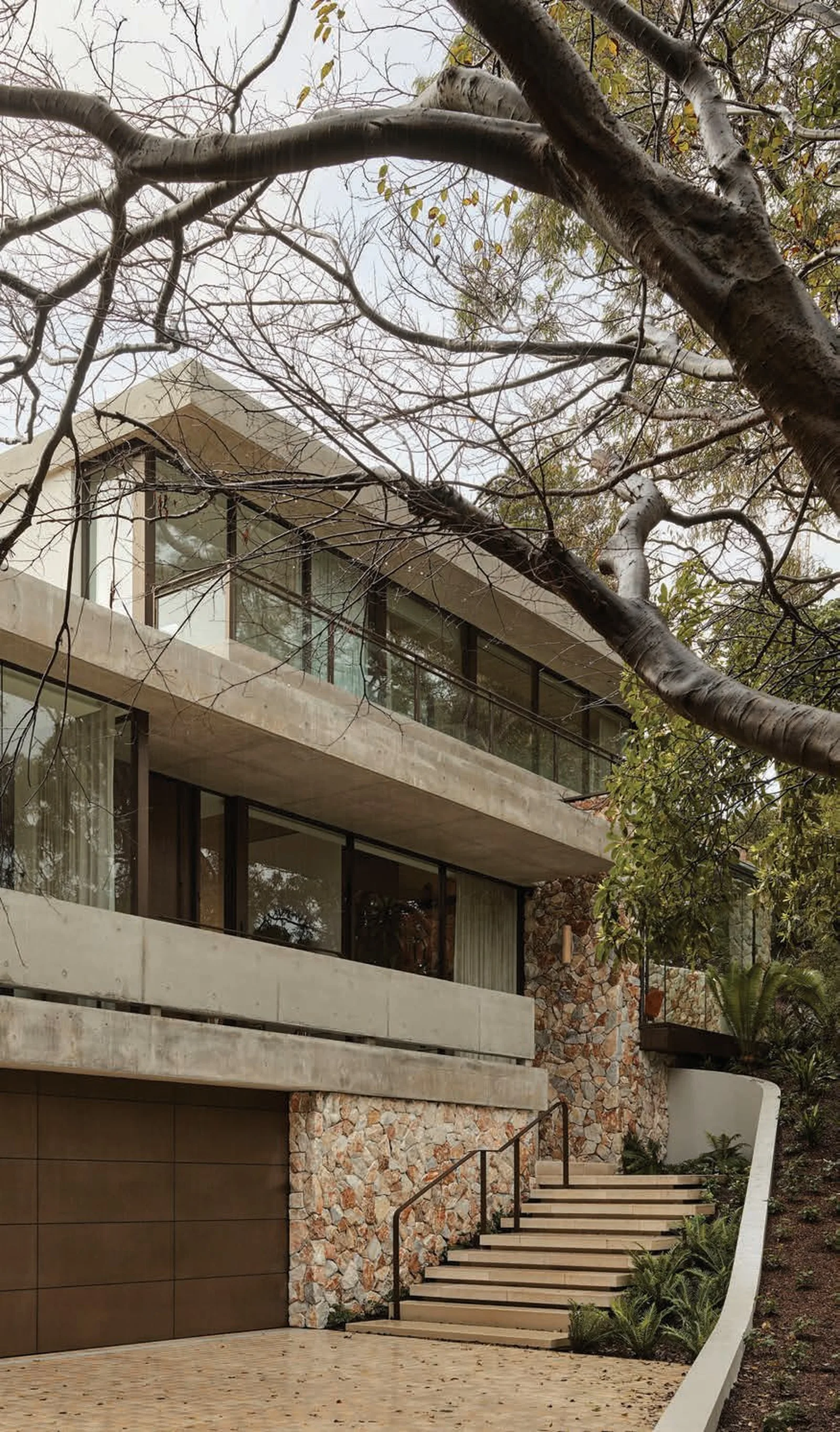
Pre-COVID, when the greenfield space in Melbourne’s southeastern suburbs was becoming scarce and prices for any vacant lots were quickly rising, builder Steve Harris realised the knockdown rebuild (KDR) market was going to take off.
“Knockdown rebuild has become popular in recent years because there has been a lot of push for urban redevelopment and recycling of land – which the government supports – to reduce urban sprawl and to reduce the cost of infrastructure needed for the urban sprawl,” says Harris, the Director of custom home builder Oak Living, based in Seaford.
“In the early days of our business we did a lot of greenfield development but now it is predominantly knockdown rebuild.
“Percentage-wise we are doing between 60 to 65 per cent of our work as KDR and, moving forward, our business will be 90 per cent KDR.”
In the past five years, more than 60,000 approvals have been given by councils for KDR in Melbourne and Sydney.
The trend is city-wide and concentrated in established suburbs with high property values, such as Balwyn North and Glen Waverley East in Melbourne.
Ermington, Rydalmere, and North and East Ryde in Sydney have also seen KDR’s sprout up, driven by people’s desire to build a modern home in a familiar location.
“The fact is people love where they live and, when they do the analysis of should they sell, they realise they’ll be paying some $70,000 in stamp duty, and all the agents fees and other charges that go with it,” says Oak Living’s sales manager Paul Martino.
“All of a sudden the thought of a KDR in the suburb where their kids are going to school and where they have ties and familiarity, starts to become a really attractive opportunity.”
The team at Oak Living identified and started targeting the KDR and recycled land market pre-COVID giving them an early jump on their competitors and the ability to adjust their business to meet the red tape requirements of councils.
“I don’t think anyone anticipated the difficulty associated with the KDR market and the ability to commence jobs,” says Harris, adding it can take nine months for the paperwork to be completed.
“The constraints imposed by councils with planning departments, the rules and regulations about being able to progress efficiently, in a lot of locations you need to tick a box completely before you can move to the next box.
“And that’s why we definitely like to be on the ground floor of any KDR so we can massage things along. We are well-prepared and armed with systems and processes so we can deal with the KDR process probably a bit better than most.”
Houses most suitable for a knockdown rebuild in Australia are mainly built in the 1950s and ’60s as they have fewer restrictions than older period homes.
“It’s that kind of architecture which has outlived its usefulness which is prime for KDR because anything older than that can be restrained by heritage overlays,” says Harris.
And a knockdown rebuild can also be more cost-effective than the alternatives with upfront pricing and the lack of uncertainty a renovation can entail.
“I had a potential client contact me the other day and he had some plans for a very small, single storey renovation as an add-on to his house,” says Martino.
“And I had to tell him that, for what the price of his renovation would cost he could probably do a knockdown rebuild for the same amount.”
§ BUILDING BLOCKS
Between July 2019 and June 2025, there were 1,120,139 new residential dwellings approved to be built across Australia, according to the Australian Bureau of Statistics.
Of that number, 19.2 per cent of these were approved on the same site as a dwelling demolition approval that occurred within the three years prior.
This equates to 35,914 dwellings per year approved in KDRs, replacing an annual average of 16,753 dwellings approved to be demolished for a rebuild.
As such, the net gain from KDRs has been an average of 19,161 dwellings per year. Most were in New South Wales and Victoria.
§ CHRIS BREEN – KDR IN REAL LIFE
Nineteen years ago, paramedic Chris Breen and his graphic designer wife Tanya bought a rundown 1960s single-storey deceased estate in Melbourne’s bayside Aspendale.
“We had been renting in the suburb and loved the area and we originally saw this house as a stepping stone,” says Breen.
Fifteen years later, with two growing teenage sons, and as the close quarters of the pandemic closed in on them, the couple decided their family had outgrown their stepping stone and it was time to move.
“We tried to buy a new house but we kept getting outbid at auction and we were running out of options,” says Breen, who started researching knockdown rebuild solutions, signing on with builders Oak Living after visiting their Cranbourne display home.
With a build budget of $500,000, the couple designed their double-storey, four-bedroom Hamptons coastal weatherboard dream home.
Six months later, with the plans approved, the family moved around the corner to a rental home so demolition and construction could begin.
“Everything went really smoothly,” says Breen, who was back in his new home 10 months later.
“Other friends of ours had done a knock down rebuild with other builders and found the process was extremely stressful. But that wasn’t the case for us. We love the result and are so happy with what we have achieved. As an experience I would build with Oak Living again because it was actually fun.”