
More pain brews for borrowers as rates hit 15-year high
The Reserve Bank's decision to lift the cash rate to 4.6 per cent was unanimous, but economists are divided on whether borrowers can expect more hikes.
CASH-STRAPPED borrowers are being warned of more hikes to come by the Reserve Bank of Australia after it lifted interest rates to a 15-year high.
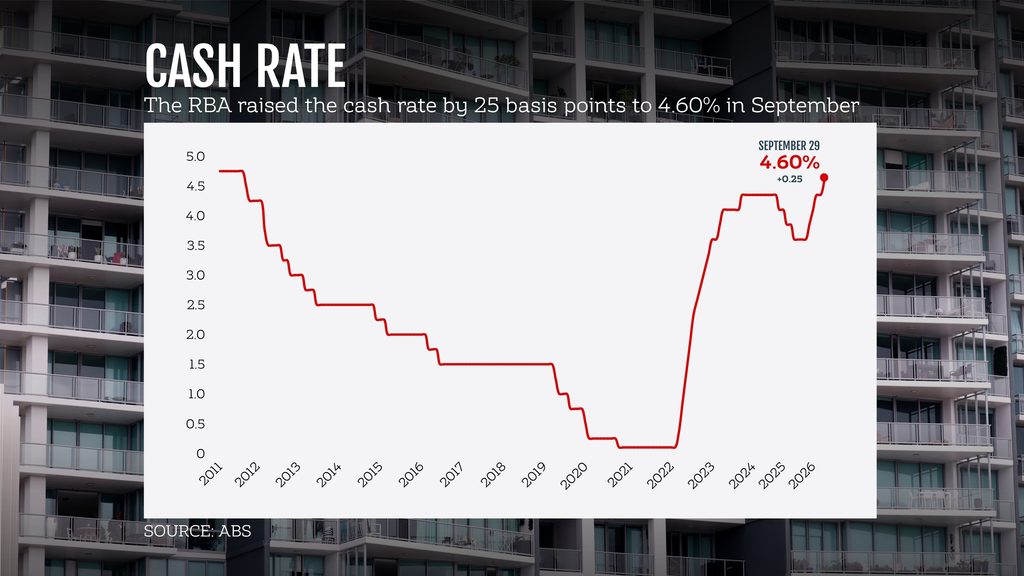
In a unanimous decision, the central bank’s nine-member board lifted the cash rate target by 25 basis points to 4.6 per cent as it wrapped up its two-day meeting on Tuesday.
Inflation was too high and the board needed to lift interest rates to get it down, RBA governor Michele Bullock told reporters in Sydney.
The move was no surprise.
Financial markets and economists had been almost unanimous in predicting the RBA’s fourth rate hike since February.
But analysts were more split on whether the board would hike again or whether the cash rate would peak at 4.6 per cent – its highest level since October 2011.
Ms Bullock’s comments that the RBA would raise interest rates further “if that’s what’s needed to get inflation down” were seen as hawkish by economists.
Other remarks – that financial conditions were restrictive, that the impact of the previous three hikes were still filtering through the economy, and that the board still wanted to preserve gains in the labour market – leaned more dovish.
Notably, a hold was discussed by the board, but not a supersized 50-basis point hike.
“This posture reaffirms our expectation that rates will remain on hold until mid‑2027,” said Commonwealth Bank senior economist Ashwin Clarke.
But a November hike was still a live possibility, he said.
Paul Bloxham, chief Australia economist for HSBC, considered a Melbourne Cup Day rate hike as his base case.
“As we see it, the RBA’s reaction function is shifting, with a greater focus now being placed on getting inflation back to target, and a lesser focus on the full employment objective,” he said.
A November hike would mean the monthly repayments needed to service an average new mortgage would be about $550 a month higher than at the start of 2026.
Traders think the RBA could have even more hikes in store, with money markets implying there’s still a fair chance of a sixth hike sometime in 2027.
But AMP chief economist Shane Oliver does not think another rate is coming in November or early next year.
By the time of the November meeting, there should be more signs that Australia’s economy was cooling, he said.
Falling house prices, a softer jobs market and rising recession risks should stay the RBA’s hand.
Ms Bullock said a recession was not the bank’s central forecast, but it might have to drive the economy into a downturn if inflation expectations got out of control.
“If that gets away, then that is a circumstance in which I think you might need to have quite a dramatic slowdown in the economy,” she said.
Earlier on Tuesday, the Australian Bureau of Statistics revealed household spending growth was flat in August.
But consumers were still on a strong footing, with household spending up 6.8 per cent on an annual basis.
The decision follows recent rate rises by central banks in the US, Europe and Japan, but Australia remains a relative global outlier.
Out of the economies classified as advanced by the International Monetary Fund, only Iceland now has higher interest rates than Australia.
While the Middle East conflict and the global artificial intelligence investment boom were adding to Australia’s inflation problem, the underlying issue was excess demand in the domestic economy, Ms Bullock said.
Treasurer Jim Chalmers acknowledged the Middle East conflict wasn’t the only factor driving inflation, but he did say it was the main factor.
“Australians were already paying a very hefty price for decisions taken about this prolonged war in the Middle East, and today that price got a bit steeper,” he told reporters in Brisbane.
KPMG chief economist Brendan Rynne said a November rate hike was odds on, but whether interest rates went higher largely came down to the treasurer.