

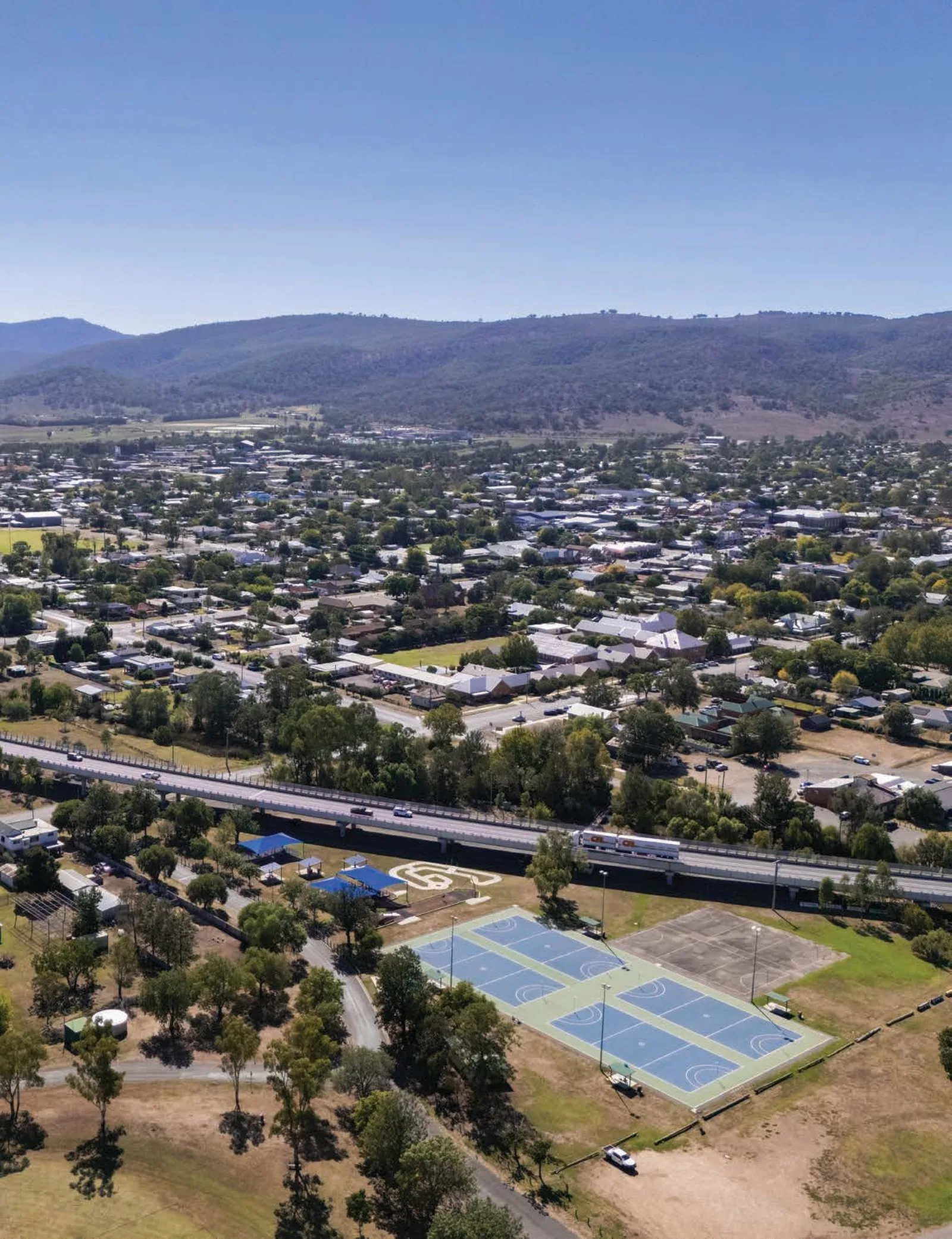
Maurice Collison is a big fan of his town’s highway bypass.
Opened in 2020, the two-lane road bypassing Scone, in the NSW Upper Hunter region, has taken about 500 trucks per day off the town’s main street.
Scone is one of many regional towns in Australia grappling with the pros and cons of highway bypasses – roads that divert vehicles from town CBDs to improve traffic flow.
According to official research, the economic impact of bypasses on property tends to be positive although that’s not always the case, with factors such as the character of the town – commercial or residential – traffic volumes and proximity to the bypass playing a part.
There’s a school of thought that taking away the busy through-traffic can see a small town weakened and its economy suffer.
However, there is growing evidence bypasses can see an affected town thrive in other ways, with it becoming more desirable for property investors and home buyers.
And this is to the benefit of conveyancers in these areas as their businesses grow with more investment in the towns.
Collison, the Scone mayor and a long-time resident of the area, says the project has led to a local revitalisation and more visitors to the “horse capital of Australia”.
“Originally when the designs came out, everyone was concerned – business, households and people,” Collison told AC.
“But I always thought it was a great thing. Because in Scone, it was very dangerous with truck movements and the amount of traffic, so when the bypass was opened, it was a great celebration.
“Our bypass – I call it a slip lane – is not that far around the town. It’s very easy to get into the town and get back out. I don’t think it’s hurt our trade at all.”
While the impact on Scone property is tough to assess, Collison’s view is the $137 million project has brought an influx of new residents, lured by the faster commute to Newcastle.
“The feel of the town has changed,” he said. “Once it was the through-traffic that characterised the town. Now it is a residential destination for many.”
§ Bypass impact: Short-term pain for long-term gain, research finds
Studies are mostly positive about the economic effect of infrastructure on regional communities, but urge caution for smaller towns
Official research, although scant, is cautiously positive on the economic impact of bypasses around urban centres.
A NSW government study, which looked at the effect of bypasses on the Southern Tablelands towns of Yass, Goulburn and Gunning, found population size, economic base and distance from a larger economic centre were main indicators of post-bypass performance.
Towns with fewer than 2500 residents are more at risk of adverse economic impacts than bigger centres, it also found.
Across the three towns, it found the economic downside of a bypass was short-term – confined to within the first year of the project opening.
Longer term, it assessed Yass and Gunning as “vibrant, growing and full of business potential as a result of the bypass”, while Goulburn had “economic development potential” despite static population and employment growth.
Another paper, commissioned by the federal government, looked at the bypassed towns of Berrima and Mittagong, south of Sydney. It, too, was broadly positive about the results.
It found Berrima, which saw a lift in tourism after the bypass, was an example of how “towns can profit from the improvement in their environment after being bypassed”.
The bypass enhanced the town’s tourist appeal by reducing the level of traffic and eliminated almost all heavy vehicle traffic, it found.
Mittagong, meanwhile, had fared less well due to a loss of traffic-serving business but “the net economic effects may still be small”.
“To these cheerful messages must be added some words of caution. Profiting from the improved environment takes initiative and a tolerance for risk,” it concluded.
“Moreover, even with optimal adjustments, bypasses may harm the economies of some towns, especially small towns highly dependent on traffic-serving business.”
Sydney
Canberra
§ Singleton set to surge as bypass opens up a wealth of opportunity
Community remains upbeat as long-awaited $700 million, 8km project promises to transform the local property market and town centre
In the NSW Upper Hunter area, the town of Singleton has worked for more than a decade to get a bypass approved.
Later this year, their efforts come to fruition when the road opens.
Some $700 million has been invested by state and federal governments on the project – an 8km stretch of road that avoids five sets of traffic lights in the town.
Mayor Sue Moore, an advocate of the bypass, said it has been a big community effort.
The genesis was the local chamber of commerce complaining about motorists not stopping in town “because they can’t get back on to the highway once they get off”.
In a bid to help, Moore said the council backed a bypass that would stay as close to town as possible, have good access on and off the main street, and ample signage.
“They were the real essential things that we started working for,” Moore said.
After being let down by initial plans, the town “stuck to our guns and luckily the deputy premier at the time saw our reasoning and added another smaller roundabout that allows better access to the CBD”, Moore added.
Moore remains upbeat about the project’s potential as its opening looms.
“We see that the bypass will open Singleton up for all sorts of development, particularly housing as we’ve got lots of stock available and rezoned ready to go,” she said.
“It’s been selling pretty steadily but, once the bypass is finished, people will see that Singleton is in easy reach to Maitland and Cessnock, which are booming areas.
“It’ll be easier to get on the highway and get to the areas of the Lower Hunter and potentially the Upper Hunter as well.”
Peter Dunne, principal of Singleton’s Peter Dunne Real Estate, is also bullish.
He predicts the bypass to lift buyer interest in the area given it will drastically reduce the number of heavy vehicles moving through town.
“Fifteen thousand vehicles go through here a day,” said Dunne, who has been a real estate agent in the town since 1981.
“It’s mainly coal-industry related. So, if you were here between 5.30am and 6.30am and didn’t know what was going on, you wouldn’t believe it – it’s a line of car lights probably 8km either side of Singleton.”
The trucks resume in the afternoon, which again “just chokes up the whole place”.
Additionally, the bypass will highlight Singleton as an up-and-coming town, he said.
“Once you get a bypass it’s a sign of how busy you are and that certainly sits well with any investor looking to put their money somewhere,” Dunne said. “To be honest, geographically, within a 170km radius of Sydney, you wouldn’t get anywhere better value right now than Singleton.”
Once the new road opens, Dunne predicts Singleton to experience the same surge in growth as nearby Maitland, which has had a bypass in place for more than a decade.
Maitland’s reputation was improved by the bypass and the town has gone on to become one of the most thriving hubs in the region.
“We’ll become a service provider, labour wise, for Maitland and Newcastle. We’re seeing some action from the Central Coast as well,” Dunne said.
“Geographically, it’s positioned ideally, and the bypass is going to ease the town pressures of traffic – it doesn’t get any better.
“The council will be able to put their money into other areas because they won’t be spending so much on the roads.”
While highway-focused businesses such as pubs and fast food outlets will likely take a hit, Dunne said that’s outweighed by the prospect of a surging Singleton property market.
He sees big upside for both investors and owner occupiers, especially families.
“There’s a lot of green space, the schools are good, accessibility to other areas, the hospital is good and you’ve got a central regional hospital in Maitland half an hour away,” he said. “It’s a well-appointed country town on the up.”
§ Road projects aim to reshape the landscape for the better
In Queensland, “future-proofing” for natural disasters is prompting bypasses.
In one case, the state government said a bypass at the town of Tiaro, north of Gympie – part of a multi-billion-dollar upgrade of the Bruce Highway – will curb the impact of floods.
The area, when flooded, has a significant impact on the national road transport network and can result in the prolonged isolation of Tiaro. Climate change has been cited as a driver.
The construction of bypasses in Queensland, such as those at Tiaro and Gympie, seeks to improve flood resilience and enhance local liveability
Nearby, Jo Yates, of Queensland-based Vendee Property Buyers, is already seeing positive results from the Gympie Bypass, located about 175km from Brisbane.
Opened in 2024, the $1.2 billion project comprises a 26km, four-lane section of highway and marked the final stage of upgrades to the Bruce Highway.
“In my experience, buying in Gympie before and after the bypass, owner-occupier buyers viewed the bypass positively due to the reduction in traffic which they perceived as safer and quieter,” Yates told AC, adding she has seen an uptick in buyer interest.
“For owner-occupiers, this is due to the increased perceived liveability and for investors this is due to the price growth that the area has seen and is expected to see,” she said.
“Day to day, the traffic is reduced which makes moving around the town easier and quicker. It also feels more like a town to live in rather than pass through.”
Yates said the new road has also made it realistic to commute to Brisbane for work, especially for those who only need to drive to the state capital a couple of times weekly.
“It has made Gympie attractive to buyers who might not have considered it before.”
On the downside, Yates pointed to a fall in trade at local petrol stations, tourist stops and truck stops as fewer motorists pass through.
When it comes to property prices, she said it’s tricky to gauge the impact.
“It’s hard to isolate bypass impact from broader Queensland market dynamics as there has been such a huge migration into South East Queensland,” she said.
“However, if we compare it to a town which is a similar demographic and also on the Bruce Highway like Nambour, Gympie has been outperforming Nambour in recent capital growth on houses. Some of this could be contributed to improved connectivity post-bypass.”
§ Bypass boom or bust: It depends on the town
Streamlined road infrastructure typically improves liveability and property appeal, though long-term market strength is not always guaranteed
Nat Gordon, principal of property consultancy Propoholic, cautions that the impact of highway bypasses on property markets varies from town to town.
Hence, buyers should assess the impact when looking at local infrastructure pre-purchase.
“A bypass will reduce road and foot traffic and noise through a town centre. That often improves liveability and appeal for owner-occupiers and investors. However, it can also have negative impacts,” Gordon told AC.
“If major gentrification of an area is undertaken as part of the bypass project, this will naturally improve the market appeal of the township as a whole.
“If a bypass enhances connectivity to employment hubs while improving local liveability, prices will usually strengthen. If it diverts trade without the town having an alternate economic driver, demand can soften.”
She points, for instance, to some bypassed towns, such as Coffs Harbour on the NSW mid-north coast, being primarily driven by tourism.
In these cases, a bypass may detrimentally impact business and employment, but it may also boost desirability for tourists due to decreased congestion. Such “lifestyle markets” with established tourism appeal, strong schooling or coastal access are generally more price resilient.
By contrast, towns such as Hexham, in the NSW Hunter region, are close to hubs of industry meaning the bypass could help increase regional productivity, while denting the town.
“Towns heavily dependent on highway trade, such as fuel stops and convenience retail, may experience an economic decline if they do not adapt,” she said.
At all times, Gordon said a key consideration needs to be whether the bypassed town has a distinct reason for people to stop, not just pass through.
“A great example of this is Berry, which is a historic lifestyle town in its own right. The bypass has been beneficial for Berry and its surrounding areas,” Gordon said, referring to the town in NSW’s Southern Highlands region.
On property, the short-term impact is that prices “generally stagnate” due to uncertainty.
“In that period, sellers will seek to gain an understanding of the effects. This will usually decrease supply. Demand from buyers may decrease but could also increase due to the perception created by the announcement,” she said.
Subsequently, the nature of the town comes into play and impacts values differently.
“If the bypass shifts the town from a traffic corridor to a lifestyle or destination market, that can be positive for long-term capital stability and growth. If it exposes a fragile local economy, the risk profile increases,” she said.
“While infrastructure and town planning principles can alter the dynamics of an area, it will generally serve to amplify the underlying fundamentals of a town rather than completely changing property markets.”
§ A BYPASS CAN FAST-TRACK A TOWN’S ISSUES
Alex Haddad, principal of Property Services Agency, warns that property values in some towns can slide as a result of being bypassed.
Haddad, a real estate industry veteran, highlights the town of Peats Ridge, north of Sydney, which was bypassed by the M1 motorway, removing it as a stop on the way to Newcastle.
“Commercial properties will drop a fair bit through the main road when a bypass is built and sometimes residential properties will drop also,” he said.
In his view, a key factor on values is if the bypassed town has a train station.
If there is rail access, then property prices will tend to go up, he suggests, pointing to the Dapto area, near Wollongong.
Dapto has a train station and has experienced a resilient property market post the Albion Park Rail Bypass, opened in 2021.
“In a nutshell, if it has a train station, it [prices] generally tends to go up when a bypass is built as it does become a more quiet town,” Haddad said.
“But if it is a bypass town with no train station, no one knows about the town, and prices drop as demand for the town drops. The town sort of gets dropped off the map, with no one passing through and no one knowing a town exists.”
Buyer’s agent Rasti Vaibhav, principal of Get Rare Properties, goes further, saying that in some cases a “bypass doesn’t kill a regional town. It just makes the diagnosis official”.
He described towns built on passing trade – fuel, fast food and convenience retail – as “structurally fragile” and said these vulnerabilities get exposed when a bypass goes in.
“The bypass accelerates an existing decline; it doesn’t create one,” Vaibhav told AC.
That’s not the case with towns offering healthcare, agriculture, education and commuter employment. They “typically experience a 12 to 18-month sentiment dip before values recover as liveability lifts and through-traffic disappears”.
“The pattern is consistent enough to be predictable: what a bypass exposes matters more than what it removes,” he said.
Vaibhav added that one element often missed in the discussion is that “experienced regional investors treat bypass announcements as a buying signal in economically sound towns”.
“Sentiment falls before reality catches up and that gap has been quietly profitable for those who understand the difference between a town in transition and a town in decline,” Vaibhav said.