

‘A WAKE-UP call.” That was Prime Minister Anthony Albanese’s immediate comment on a long-awaited government climate report issued in mid-September.
The National Risk Assessment led by the Australian Climate Service has sobering, even confronting warnings.
It found a million homes could be at “very high risk” from rising sea levels by 2050, and effectively uninsurable.
The report also predicted a loss in property value of $611 billion within 25 years, and $211 billion in lost productivity.
That’s based on a 2-3 degree Celsius increase in global warming. Other threats include:
More frequent and severe extreme events such as floods, fires and cyclones. Heatwaves leading to many more deaths, especially in northern Australia. Up to 70% of native plants facing conditions outside their climate range, risking species loss and ecosystem collapse.
“Climate hazards will get worse under all plausible futures,” the report noted.
The Climate Council’s CEO found the contents “terrifying,’ the Greens “chilling”.
Bad news for all, in a country where floods, bushfires and coastal erosion have already cost tens of billions of dollars.
The Risk Assessment was released in the same week as updated climate guidelines for property professionals.
The Law Society of NSW noted its advice could “affect the many solicitors who undertake conveyancing work and the home buyers or sellers whom they advise.”
“Climate-related issues can include advising on bushfire or flood risk and the affordability, or even availability, of insurance,” Law Society President Jennifer Ball added.
Availability of insurance, in turn, could affect the ability to obtain mortgage finance.
The updated guidance suggests lawyers have a duty of care to “meaningfully address” any climate change issues and their consequences.
Mieke Elzer, Property and Commercial Senior Associate at Attwood Marshall lawyers, says flood, fire and heat risks can leave a home unsellable or uninsurable.
“The assumption that property is always safe, always appreciating, is steadily being dismantled,” she said. “That reality has legal and ethical consequences.
“Should governments still approve subdivisions on floodplains? What liability attaches when a council looks the other way? And who should bear the cost when one person’s coastal home… becomes a collective financial burden? These are not hypothetical questions. They are playing out now in insurance refusals, lending restrictions, and stranded assets.”
Those who are purely conveyancers don’t appear to have the same responsibility as lawyers, but most would discuss obvious climate risks with clients.
NSW conveyancers check a property’s status via the Section 10.7 (formerly Section 149) certificates issued by local councils. These provide details of a property’s zoning, planning controls, and restrictions on development.
But it should not be assumed that the client fully understands the implications.
The Law Society of NSW says, “A solicitor has a duty to warn a client about potential risks… which should be obvious to the solicitor but that the client may not appreciate.”
The Law Council of Australia has also addressed the issue, its Climate Change Policy stating: “Lawyers should be alive to the unfolding implications of climate change,
“They should be informed, skilled and ready to assist clients on climate change-related legal matters, within their areas of skill and competence.”
One tool used by many conveyancers is the Groundsure ClimateIndex Report, which assesses flooding, bushfire and coastal erosion risk up to 30 years hence.
“Going forward, climate change represents perhaps the single greatest risk to both property values and peace of mind,” Groundsure notes.
§ SAFE AS HOUSES?
It’s often said of real estate that they’re not making any more of it. Unfortunately, for many, bad weather is making less of it, especially on the NSW east coast.
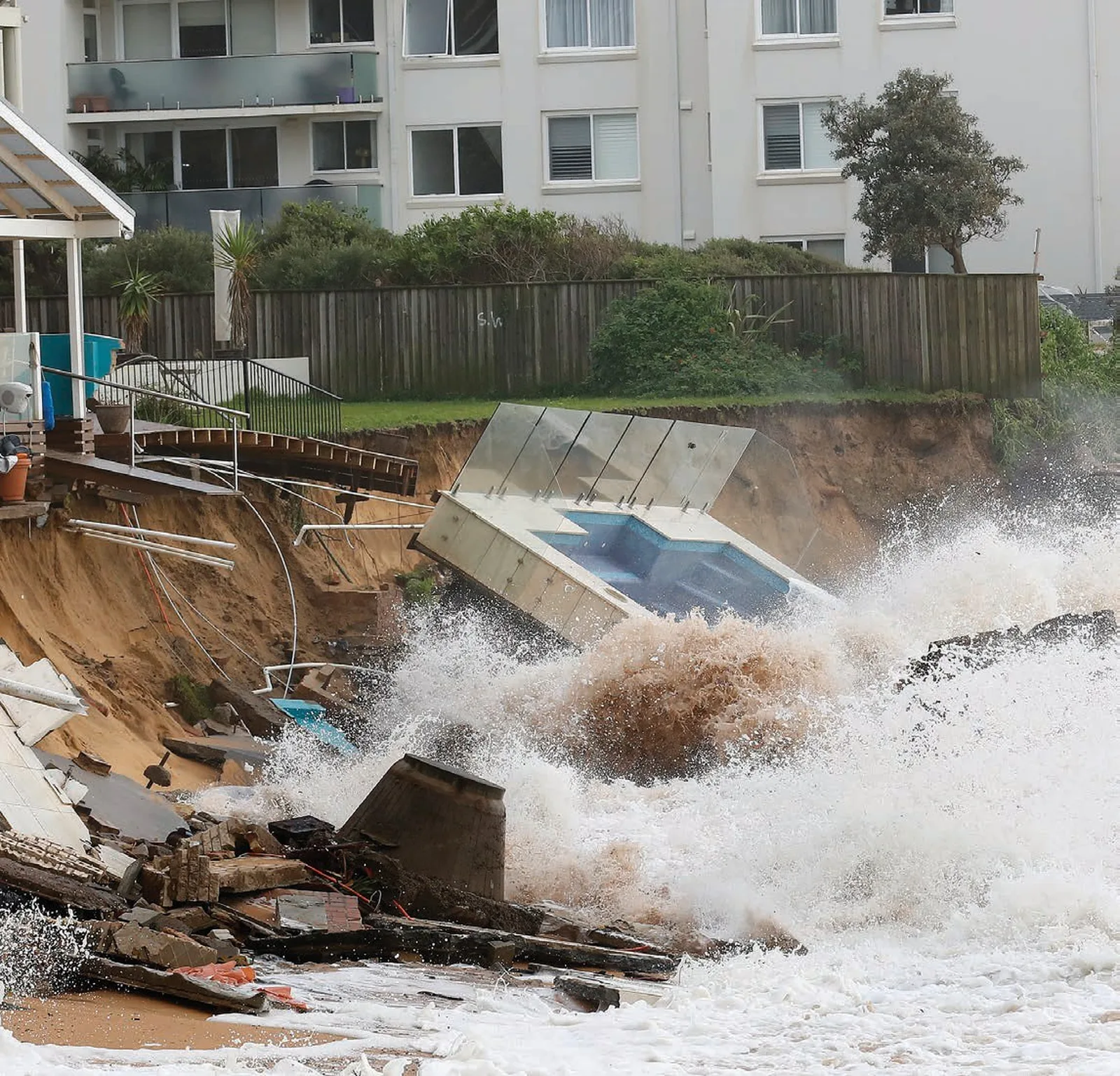
Erosion caused by severe storms and king tides has stripped sand, land and homes from several areas, notably Wamberal Beach just north of Sydney.
It’s been subject to dynamic change at least since European settlement. The Aboriginal word Wamberal means “where the sea breaks.”
The 1960s saw significant sand buildup, encouraging development. But in 1974 major storms threatened beachfront properties, with one home damaged.
Two homes were lost in 1978, with more damage in 1995, 2007, 2016, 2020 and again this year.
Many stakeholders are seeking a Terminal Protection Structure or 1.5km vertical seawall, plus sand “nourishment” as required.
The estimated cost is up to $40 million, with annual maintenance of $265,000.
Buying back the properties would cost up to $1 billion. Central Coast Council’s cleanup bill from the 2020 storms was $2.1 million. “The costs are simply unaffordable and unrealistic,” it says.
A 1.3km-wall at Collaroy-South Narrabeen on Sydney’s northern beaches cost owners, the council and state government $25 million. A new seawall at Nielsen Park in Sydney’s Vaucluse cost $20 million.
Other beaches are under threat at Byron Bay in NSW, Fremantle WA, Victoria’s Inverloch, and Post Office Rock near Beachport, SA.
One review found that if global average sea levels rose 1.1 metres, up to 247,600 Australian homes would be at risk.
Sea levels have risen about 20cm in the past 100 years, a rate said to be accelerating due to global warming.