

BUILD up, not out: a mantra that’s been around for some time but lately gathering pace and heading skyward like a SpaceX rocket.
City planners and politicians say the urban sprawl seen around most Australian cities is no longer affordable, nor sustainable.
We need high-rise buildings in key centres, on major transport hubs and in Central Business Districts where thousands work by day but go home to the suburbs at night.
“It’s crazy that downtown Sydney has fewer than 30,000 people living in it,” says Business Sydney executive director Paul Nicolaou.
“Our city could easily support a residential population of 200,000. Cities such as New York, London and Paris have done this for generations.”
As noted, it’s not a new idea, but long resisted by NIMBYs and those who dream of a single-family home on a quarter-acre block.
High migration and housing shortages mean our capitals can no longer afford that luxury. The government wants 1.2 million new homes within five years.
Queensland alone anticipates that by 2050, it will have a population of around 11.7 million, double the current number.
Around half are expected to be migrants, with 80-90 per cent concentrated in the southeast.
“It’s a hell of a lot of growth in a fairly small area,” says Nicole Bennetts, national head of advocacy for the Planning Institute Australia.
She sees many being accommodated in medium to high-density housing, because unlimited urban sprawl is unsustainable.
And unaffordable: extending infrastructure to new free-standing homes adds an estimated $70,000 to each.
“That’s a big difference,” Bennetts says, “and among the biggest drivers for why we have to accommodate the right homes in our existing areas.”
City skyscrapers are one option, along with inner-suburban medium-density development.
But all need that vital infrastructure: transport, parks, shops, medical and education facilities, including “vertical schools” in CBDs.
“Public transport is key,” Bennetts adds. “Bus and rail services, and also active transport: cycleways and footpaths.”
Luke Whistler, Deputy Chair of the Infrastructure Association of Queensland, agrees that growth needs to be focused in established, well-connected areas.
“This allows us to upgrade existing infrastructure rather than undertaking the immense cost and resource burden of extending services into the fringes,” he says.
Whistler believes a co-ordinated approach to development and infrastructure will “future proof” our cities.
“It will ensure we create resilient and connected communities that are fundamentally more liveable for a growing population,” he says.
Whistler names Brisbane’s Stones Corner, a designated renewal zone just 4km from the CBD, as a great example of an old neighbourhood on the up-and-up.
Plans for high-rise housing, especially in those middle-distance suburbs, often bring a knee-jerk negative response.
But Bennetts feels that attitude is changing, especially among migrants and millennials.
“They don’t want to live on the outskirts of town,” she says. “They want a more compact environment and not have to mow lawns on the weekend. That Great Australian Dream is changing.”
Adelaide has embraced upward mobility as it plans for 50,000 extra people by 2036.
“Adelaide, like all Australian capitals, is going up,” Lord Mayor Dr Jane Lomax- Smith told AC. “As a council we support this growth in high-rise living.”
Affordable housing is a key part of Adelaide’s mix. And the city has dedicated funding to promote re-use of vacant commercial or “stranded assets” for residential use.
City living offers significant economic benefits. If you live in the city, you’ll likely work and socialise there, too: creating more jobs, wealth and spending.
“It’s all about having people in close proximity that creates that urban agglomeration benefit,” Bennetts adds.
In other words, the city becomes an engine of productivity.
“We keep looking for the ‘secret sauce’ when the recipe for economic growth is obvious,” says Business Sydney’s Paul Nicolaou. “People make the difference.”
New single-family homes surrounded by lawns and trees will still be available, but they could become increasingly expensive and isolated.
Planners speak of a 70/30 rule, where 70% will be infill development, just 30% on greenfield sites.
A notion backed by the Government’s National Urban Policy, which notes that nearly 80% of the population now lives in our 20 largest cities.
“Our inner-city rings are characterised by higher population density and high access to employment, services, infrastructure, public transport and amenities,” it states.
“Middle-city rings typically have lower density than inner-city areas but often have high-density precincts around public transport hubs.
“Outer-city rings represent suburban Australia, typically including established and greenfield urban suburbs, and surrounding rural areas. As our cities grow, middle and outer-city rings often experience stresses on infrastructure.”
The consensus is that more high-density – and high-reaching – housing is inevitable.
With good planning and regulation, it should be more affordable, and more sustainable.
It could also prove an economic bonanza for conveyancers, with at least one of Sydney’s planned new skyscrapers having some 1,500 apartments.
§ CONVEYANCERS BEWARE: Pitfalls of high-rise dwellings
CONVEYANCERS are being warned that high-rise dwellings could present big legal challenges for them, and their clients.
The issue is that many residential skyscrapers are mixed use and mixed tenure, with apartments for sale or rent, plus shops and office space with differing strata laws.
Property law expert Cathy Sherry from Macquarie University says Sydney’s Wentworth Point, 12km west of the city, is a prime example.
Professor Sherry says the suburb, built on former industrial land, was part of multiple strata schemes inside multiple community schemes inside an overarching strata subdivision.
“It is incredibly complex,” she told a recent AICNSW state conference. “The sales contracts for an apartment at Wentworth Point are 680 pages long.”
One apartment could be regulated by “29 pages of strata by-laws, 47 pages of community management statement and 110 pages of a strata management statement.”
“It’s 187 pages of privately written rules that you and your clients should have read,” she said.
“When we’re talking about undercharging for conveyancing this is the kind of thing that’s going to take an enormous amount of time.”
For example, by-laws might prohibit children from rollerblading or skateboarding on common property.
“That’s because it’s privately owned property and under the legislation the owners are compelled to have insurance,” Prof Sherry explained.
§ HIGH-RISE HOTSPOTS
Planning is proceeding for Bays West, near White Bay power station, just 2km west of the Sydney CBD, with a new Metro station to open there by 2032. Building heights are slated to be up to 25 storeys.
The State Government is also planning to use a former Metro dive site in Chatswood’s CBD for up to 1,500 new homes, including 180 build-to-rent apartments. Plans are yet to be finalised, but artists’ impressions indicate towers of at least 40 storeys. Homes Victoria is redeveloping 44 public housing towers across the inner city.
There are also plans for high-rise residential and office towers near 50 public transport hubs or “activity centres,” with heights of up to 20 storeys.
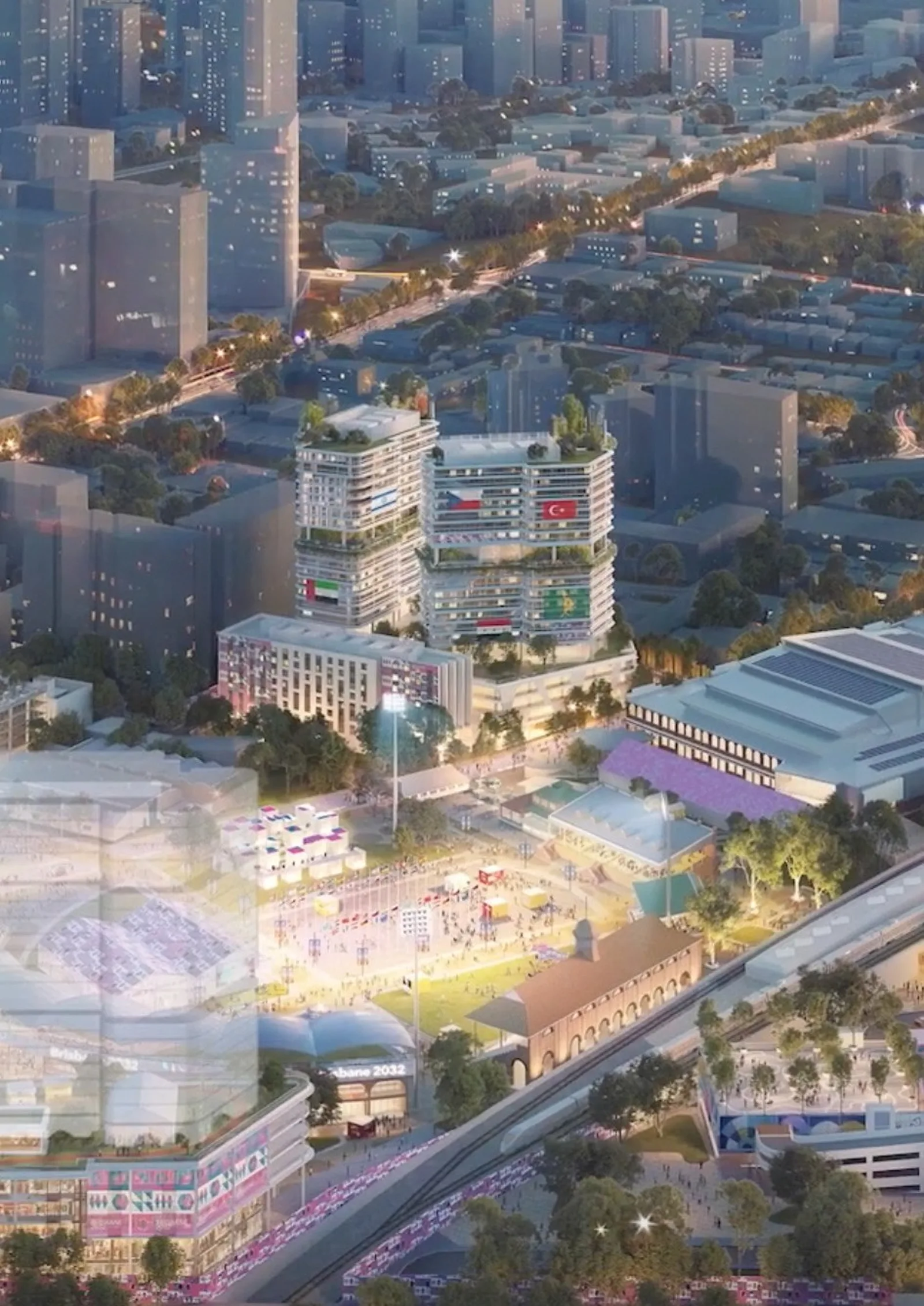
Among the core areas are Hawthorn, Oakleigh and North and Middle Brighton. The 2032 Olympic city aims to build 210,000 homes in the next 25 years, with areas such as inner southern Stones Corner earmarked for 2,000 new dwellings by 2046, an increase of about 1,200.
Other renewal plans are underway further south at Mt Gravatt, the northern suburb of Alderley, and bayside Wynnum.
Adelaide has more than 30 major projects worth more than $10 billion planned, approved or under construction. The tallest include Festival Tower Two at 38 storeys and Keystone Tower at 37 storeys.
They are commercial or hotel developments, but there are plenty of high-rise apartments, too. They include the 122-metre Victoria Tower on Grote Street, with 285 apartments, and Tapangka on Franklin St, with 392 apartments. Our western capital hasn’t had to be told to build up, already boasting 30 buildings at 100 metres or more, with five exceeding 150 metres.
Residential towers include Civic Heart and The Towers at Elizabeth Quay, with riverfront Burswood Point and Garden Towers under construction. Darwin has several residential towers, with the tallest being the 33-storey Evolution on Gardiner, completed in 2008.
There are also Mantra Pandanas (29 floors), Soho Apartments (28) and Skytower Apartments (21). Others are underway or in planning. Hobart is not exactly a high-rise hub. Locals are very protective of their historic cityscape, with modest height limits. Among its tallest residential buildings are the University of Tasmania’s student accommodation (15 storeys) and Empress Towers (12 storeys).
Wrest Point Casino Tower, a few kilometres away at Sandy Point, opened in 1973 and remains Tasmania’s tallest at 19 storeys or 73 metres.