

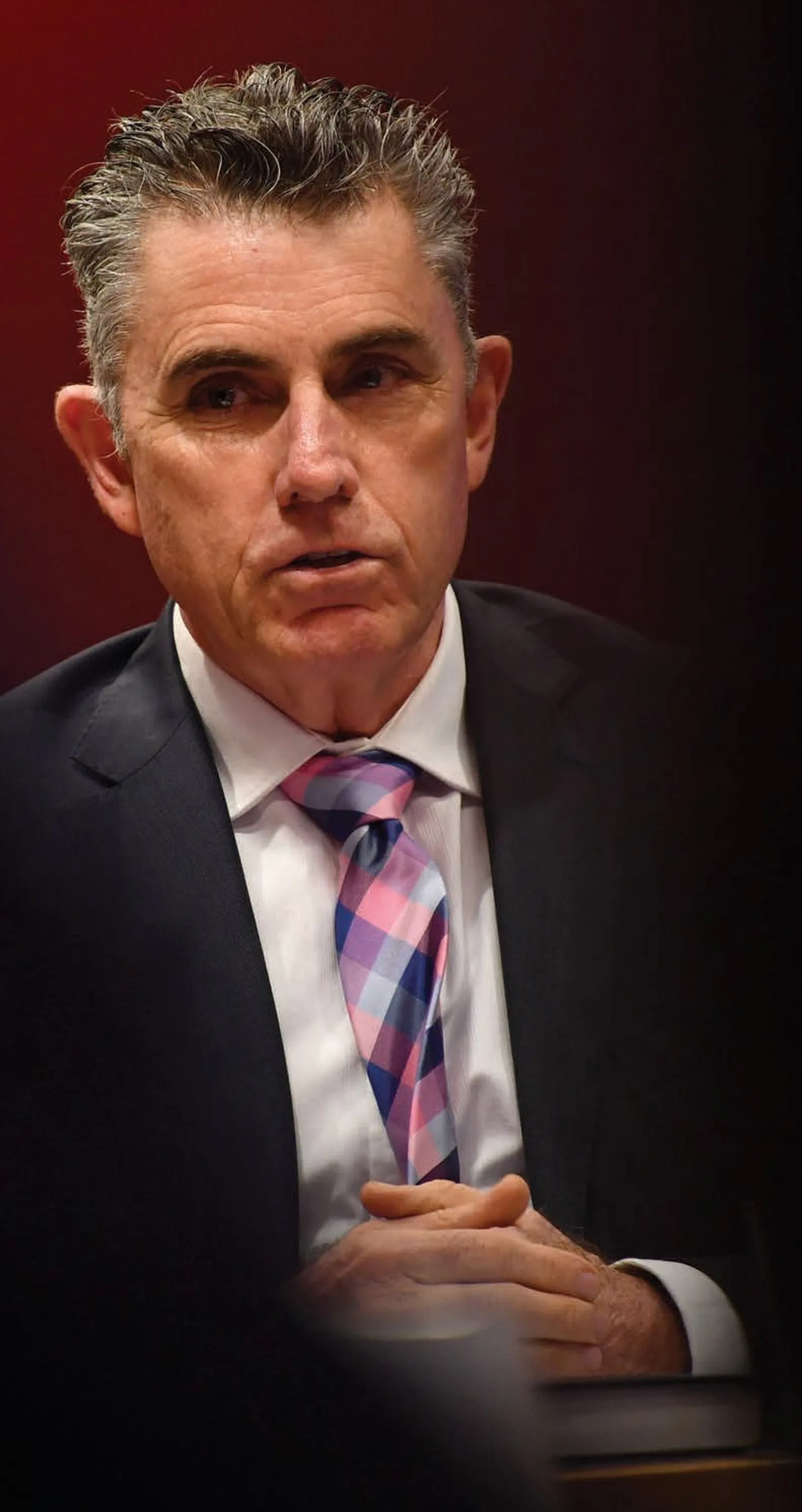
The Real Estate Institute of NSW is hoping the start of the traditional September selling season will show signs of an industry recovery after a particularly brutal year for vendors, purchasers and agents.
“I can’t remember a time when auction clearance rates were sitting this low,” Tim McKibbin, chief executive of REINSW, said of the midwinter softening of clearance rates to between 41 to 48 per cent – half of the record clearance rate of 89 per cent set in 1997.
“The market has been very flat this year but I think we’ll start to see some more activity now with the selling season kicking off.
“People need to come to grips with what the market is telling them because the expression that the market never lies is true.
“And what it’s telling everyone is that the prices the market was achieving 12 to 18 months ago are not going to be achieved today.”
McKibbin said the NSW property sector has been experiencing a “perfect storm” of unhelpful pressures, including rising interest rates, cost-of-living increases, labour costs, hiked prices for goods and freight – with rising fuel prices affected by the Middle East crisis, state government inaction and a fractured supply chain.
“There has been a lot of bad property news out there which all started with the interest rates going up,” McKibbin said.
“Prices are ultimately set by purchasers, not agents or vendors, as seen clearly at auctions.
“The cost of capital has risen so, from the purchaser’s perspective, they can’t service as much debt as they could six to 12 months ago. The amount of money they have in their pocket now at auction has decreased.
“From a vendor’s perspective, they’re going to have to start listening to the market and will have to painfully come to the realisation that they’re not going to get the price they think they will.”
Meanwhile, in other pressures on the industry, McKibbin estimates NSW is “hundreds of thousands” of homes short of the supply needed to meet demand for housing across the state, especially with 10,000-plus new immigrants arriving in the state each month.
“There’s a lot of people coming into NSW every month,” he said, “and the rhetorical question is, ‘Where are they all going to live?’”
McKibbin believes the government should have the “courage” to implement novel strategies to alleviate the housing situation.
“I would like the government to take the politics out of housing and to adopt some bravery and go in and do what is required, which is to build more homes,” McKibbin said.
“Everybody says that the problem is supply. I think supply is the result of the problem and the real problem is political courage.
“The government just has to take a firm hand and say, ‘We’re going to build here’.”
McKibbin said the Minns Labor government should be considering unconventional options in terms of development locations, including giving developers the public airspace above transport infrastructure.
“I believe we’ve got to be somewhat novel in our thinking,” he explained. “So, if I was in government, I’d be saying to developers, ‘How about we give you the airspace over railway stations?’
“We’ll gift it to you but, as part of that deal, you’re to build properties that are capable of responding to the specific needs of people in the community.”
McKibbin said building over the top of transport routes would provide many benefits for residents, including removing the need for car ownership and contributing to their overall health and wellbeing.
“If you build smartly, you can make an argument to people that they don’t need a motor vehicle,” he said.
“Each day they take the lift from their home to the train station, go to work, come home and there’s a shopping centre on the ground floor where they can shop for dinner and there’s all the other retail shops they may need.
“And on the first floor, they have all the other services, like doctors, dentists, gymnasiums, childcare, all of that. And then, above that, they’ve got their accommodation, their home.
“I think that we need to build higher density quality homes in a high-rise environment.”
McKibbin said the social and health impacts of long commutes, when people cannot live near where they work, are immense.
“More time spent travelling results in higher rates of conditions like diabetes due to less time spent exercising,” he said, “while family relationships can be strained because people leave and return home in the dark.
“We need to be building where people work instead of them having to commute for hours every day.”
While the “cool market” conditions prevail throughout NSW, McKibbin is loath to pinpoint any regions which may experience growth in the near future.
Although he said looking at the “micro effects” of a region – like knowing whether a new mine is opening or an abattoir is closing – can help predict whether an area will boom or bust.
To ensure growth and sustainability outside of the big cities, McKibbin said he would encourage developers to locate AI data centres in regional communities.
“We’re talking about building these massive data centres now,” he said.
“Would you build them in the middle of Sydney when the land costs you a gazillion dollars? Or would you take them out into a regional area somewhere?
“If you go regional, you take the jobs with it and then you also get the ancillary jobs that come with having additional people in that area.”
And while McKibbin’s mantra is “listen to what the market is telling you”, he said purchasers in this flat market shouldn’t become too complacent.
“Obviously, if you’re a purchaser you want to buy in a market where the prices are dropping,” he added.
“But you’ve got to say to yourself, ‘How far down is it going to go?’
“The last time I looked at it, the median house price had dropped 0.9 per cent and I’m not saying it won’t drop more than that. I think it’s probably likely it will.
“But if people are sitting around saying, ‘I’m going to wait until it comes off 30 per cent’ or something like that, I think they’ll miss the boat.”
§ THE SPIRIT OF COOPERATION
The Real Estate Institute of NSW is actively encouraging closer relationships between real estate agents and conveyancers by developing new tools aimed at “maximising cooperation” between the two professions.
REINSW CEO Tim McKibbin says his team has been working closely with the Australian Institute of Conveyancers (AIC) to develop its Vault platform, designed to cut through the compliance red tape of property transactions, as Anti-Money Laundering and Counter- Terrorism Financing (AML/CTF) legislation takes effect.
“We have the benefit of having Jennie Tonner [President of the AIC NSW] on our board,” McKibbin told AC. “As such, the REINSW – in conjunction with the AIC – has built an AML solution called Vault, a secure environment where transactions, movement of money and communications all take place inside Vault.”
McKibbin said Vault integrates and streamlines the activities and workflows of conveyancers and real estate agents.
“They can go inside that secure world and the system will bounce through prescribed workflows, which the agent is prompted to select,” he explained.
“So if it’s a private treaty, they’ll go on that journey. If it is an auction, they’ll go on another journey. From an AML point of view, they’ll be prompted to do their risk ratings, that sort of thing.
“The system presents the questions. So the agent will then be able to answer the questions that are required of them and the system will respond to that.
“So we’re looking at implementing as much automation as we can.
“And all of that is designed within a relationship with the AIC where we can work closer together, have visibility of each other’s pain points, and be able to get the job done as fast as we can.
“It should be a relationship of maximising cooperation.”