

Imagine buying a house and finding out, post settlement, that you’re not allowed to build a nuclear reactor on the site.
OK, that’s an extreme example, but allegedly a real case of a “restrictive covenant” placed on a UK property.
More common are restrictions on operating a brickworks, coal mine, tannery, fish processing plant or butchery. Even when the property is an upstairs flat.
Others include bans on fairground rides, caravans, bear baiting pits, boxing booths or brothels.
It’s not unusual to find restrictions on raising pigs, chickens and racing pigeons. However, there’s a lease that specified “the tenants may keep one hamster”.
Another, that a flat couldn’t be rented to “lunatics or anyone of ill repute”.
In Britain, such bizarre clauses and oddities have survived for decades, even centuries.
But a UK tenancy agreement as recent as 2019 allegedly had this, as a rider to a no-smoking rule: “Tenants will buy the landlord a birthday present.”
In a similar vein, a Queensland real estate agency offered, in 2021, to facilitate an exchange of Christmas gifts between tenants and landlords, saying “we just wanted to do a nice thing, that’s all”.
Australia’s restrictive covenants are usually designed to protect the amenity of a neighbourhood, like bans on pets or hanging washing from the balcony.
Dawn Barry, of Victoria’s Skilled Conveyancing, knows of a rural subdivision where grass had to be kept to a specific height.
It’s not unique. The usual stipulation is turf no longer than 200mm.
Casey Arslan, of NP Conveyancing in Pottsville NSW, said the local Koala Beach subdivision (see opposite page) requires owners to drape a 50mm rope into their swimming pools.
Why? “To allow the native animals to escape should they fall in the water,” Arslan added.
Debbie Hutton, from Devonport’s Debbie Hutton Conveyancing, cited a local example banning “pigs, greyhounds or racing pigeons”. “This one amuses me,” she said. “So, we can have goats or sheep?”
Another forbids the use of recycled materials (even bricks) or building a house on the land for less than $8000, which should be easy to comply with.
Obviously outdated but still on the title.
“In Tasmania, they’re contained in the Schedule of Easements,” Hutton said, “and generally carry through all the subsequent subdivisions.”
Susanne Mosely, of Hunter Legal & Conveyancing in NSW, cited one that appears to dictate the purchaser’s diet.
“Minimal homegrown produce,” it reads, “is to be limited to 10 per cent fruit and vegetable intake on any Burdened Lot”.
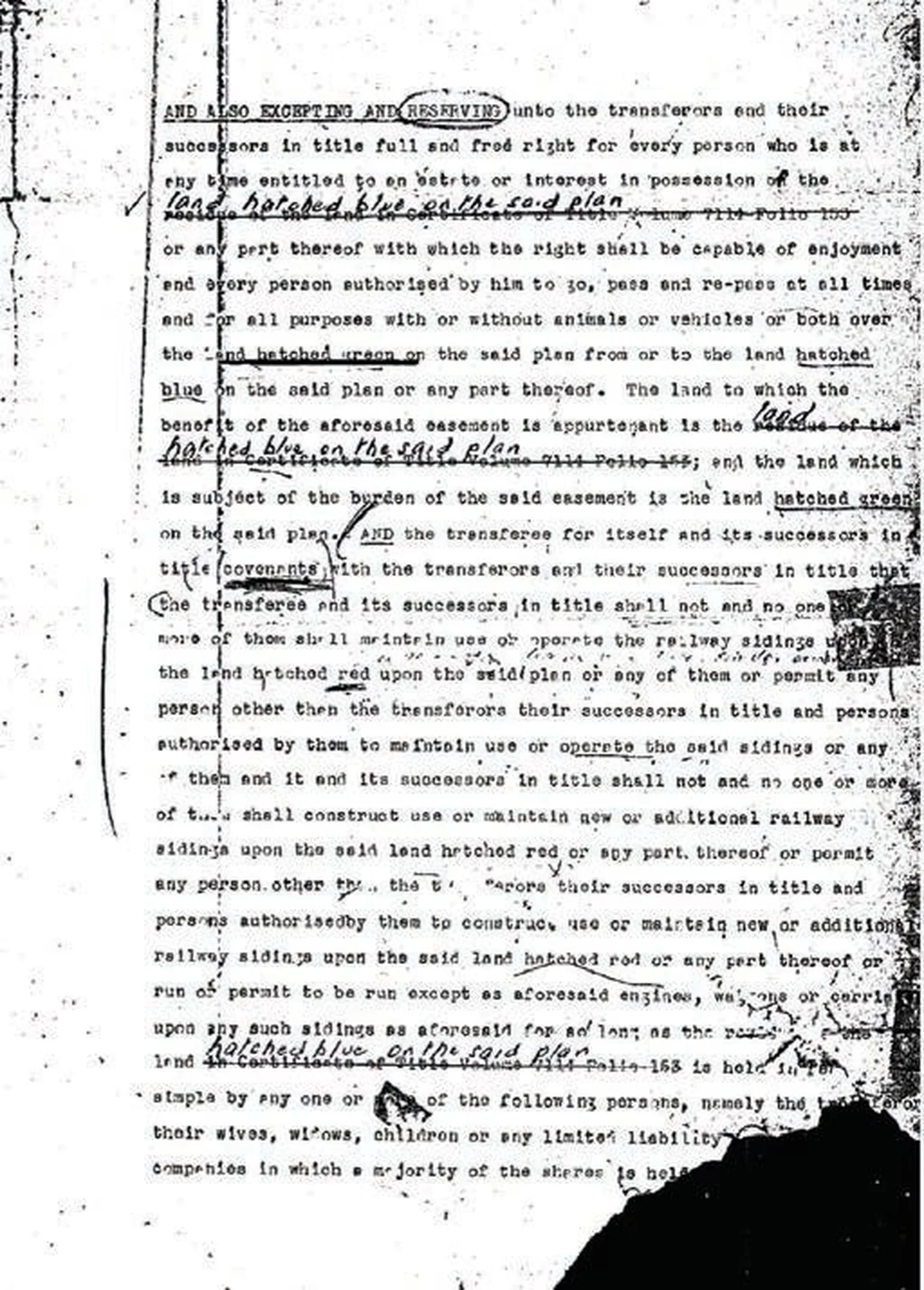
Di Cooke, of Verve Conveyancing, found another for what is now a standard residential block in New Lambton NSW that dictates rules for railway sidings and passage “with or without” animals and by “wagons or carriers”.
“There is no way that the property would be used for such purposes now, even though the covenant remains registered over the property title,” Cooke said.
It also carries to the “wives, widows and children” of the landholders. “Perhaps it was the case that the land was held by a man, or men, only!” she added.
Covenants might not be on a title but nonetheless enforced by local authorities.
Sydney’s historic “garden suburb” of Haberfield, for example, has strict codes to preserve its Federation architecture.
They were created in the early 1900s by developer Richard Stanton but are now part of local planning rules.
For example, roofs must be of slate or unglazed Marseille tiles and driveways of twin tracks with grass, garden or gravel between.
Elsewhere, restrictions may be governed by whether the property is strata or Torrens Title.
If strata, the owners corporation will enforce the law. Those with Torrens Title might think they’re king of their castle… but not always.
Torrens guarantees ownership but a restrictive covenant on a title “runs with the land”.
In other words, the benefit and burden of the covenant relate to the land itself, and not to the owner of that land.
A restrictive covenant might be removed by appeal to the beneficiary, the local council, planning minister or Supreme Court. However, that would be a costly, complex and time-consuming process.
Better not to be caught out in the first place. That’s where a conveyancer’s work is vital.
Their job is to look out for “encumbrances, caveats and notices” on property titles, especially those hidden in the fine print.
“While they may just look like another notation on a title or clause in an 88b, their impact on how a property can be used, developed or enjoyed can be significant,” Mosely says.
“A good conveyancer knows what to look for, recognising when something doesn’t quite fit, asking the right questions and making sure the client understands exactly what they’re buying.
“It means going the extra mile to protect our clients. Because when it comes to property, the unusual details are often the ones worth investigating.”
Like that ban on backyard nukes. Some vendors are such spoilsports.
§ KOALA BEACH ESTATE: HOW RESTRICTIVE COVENANTS ARE PROTECTING KOALAS
Koala Beach Estate is a residential development between Pottsville and Hastings Point on the NSW Tweed Coast.
The former cattle property has more than 500 homes, with 270ha or 74 per cent of the land reserved for nature conservation.
It’s home to koalas and at least 24 threatened species. Their protection is governed by strict covenants, including:
A 40kmh speed limit; Restrictions on dogs and cats; Preservation of koala food trees; and A 300mm gap under fences for free passage of fauna. The most interesting is this: “By means of a Covenant under Section 88B of the Conveyancing Act 1919, all swimming pools installed by future residents of the Koala Beach Estate must include a stout rope (minimum of 50mm diameter), one end of which is to be secured to a stable poolside fixture, the other end of which must trail in the pool at all times.”
The aim is to enable koalas that might fall or venture into a pool to climb out again.
The rules are enforced by Tweed Shire Council under a 58- page Koala Plan of Management.
“I advise my clients that while covenants remain registered on title, they need to be followed,” said local conveyancer Casey Arslan, of NP Conveyancing.
It seems to be working well. Koala Beach Estate has been hailed as a model for koala-friendly development and even became part of the curriculum for the North Coast TAFE diploma of Business and Real Estate.