

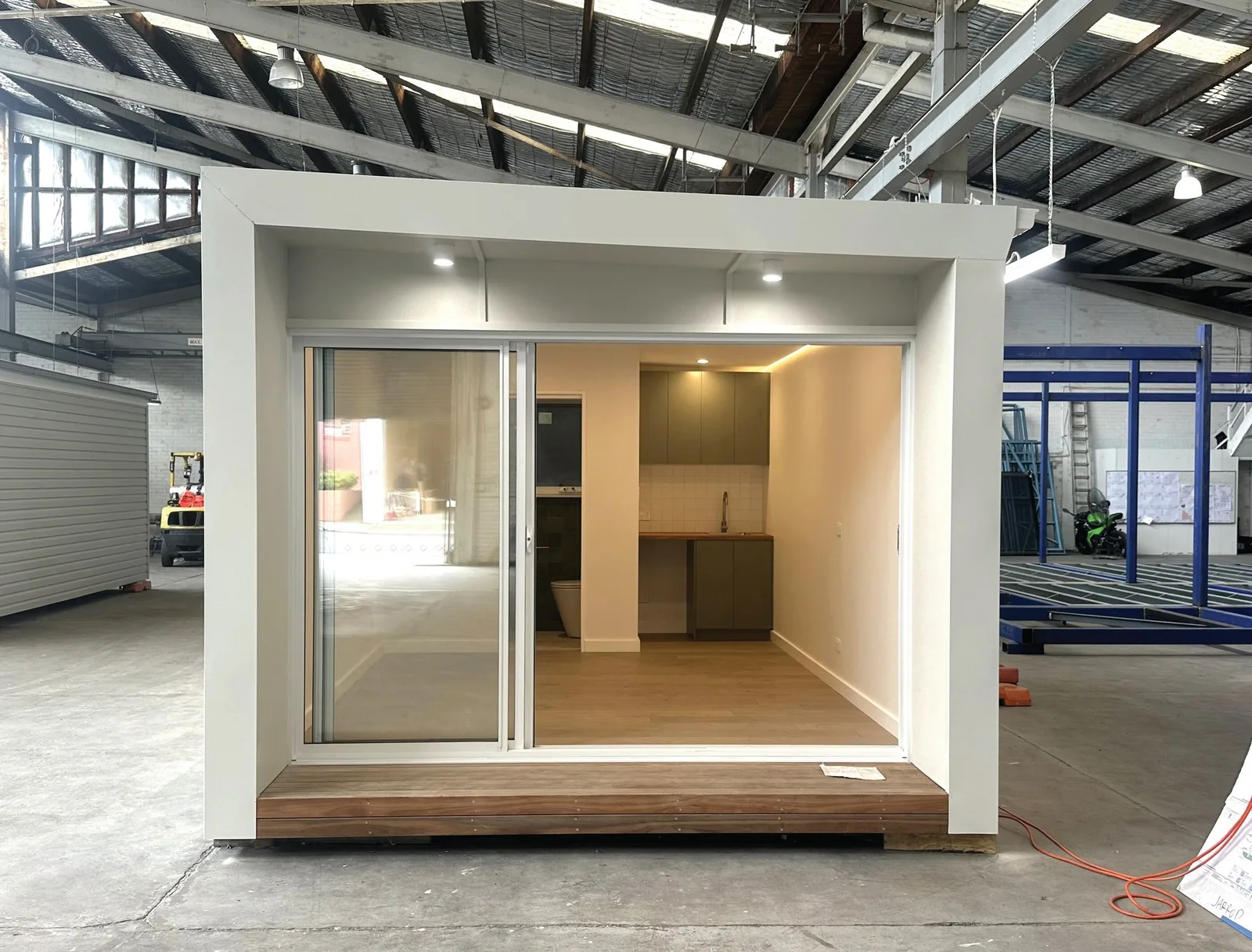
IT generally takes approximately a year to build a new house in Australia. But imagine if that time could be cut to just a couple of months for a four-bedroom home. That’s from the designer’s sketches to the housewarming party, complete with beers and bangers on the barbie.
We’re not talking about sheds here, but quality living spaces. It’s the promise of Australia’s burgeoning modular industry: precision homes, flats and garden studios, factory-built and assembled on-site.
Theo Cominos is a general manager of Keep Modular, based at Croydon in Sydney’s inner west. It was founded in 2011 and now is “going very, very well.”
Each building takes four to eight weeks in the factory and is then trucked to its new address.
“We can assemble a single-module garden studio in less than three days; a single storey four-bedroom home in less than two weeks,” Cominos says.
Keep’s units are steel framed for durability and rigidity, with wiring and plumbing pre-installed, even fully equipped kitchens and bathrooms. Clients can choose from stock packages or use their own or the company’s in-house designers. Keep also obtains all permits, surveys and reports.
Modular dwellings have an estimated 3 per cent of the new housing market in Australia, but in some parts of Scandinavia it’s a remarkable 80 per cent, driven by harsh weather and steep terrain.
“Modular seems to have grown out of necessity in those regions,” says Keep’s joint GM Anthony Achjian. “Here it’s cost and time that are the pressing issues.”
The cost can be a considerable saving over traditional construction: maybe $2500 a square metre for single-storey, $3000 for double storey. But Keep can make modular construction look traditional, faced with brick or sandstone or inserted behind existing facades. “A few of our customers want interesting options that nobody would pick to be modular,” says Achjian.
That’s a plus when it comes to building in heritage suburbs. Cominos says local councils are generally cooperative. “They’ve by and large gone above and beyond to assist us,” he says.
Banks are also on board, the Commonwealth offering specific modular loan options. So is the federal government, allocating $54 million in the March Budget to support prefabricated and modular home construction. There’s $49.3 million to invest in local programs to grow the industry, and $4.7 million to develop a national certification process.
After just six months at their current factory, Keep Modular is already running out of room. “A lot of developers approach us and ask for multiple dwellings at once, and we simply don’t have the space,” says Cominos. “So we’re looking for bigger premises.”
§ New home? BYO screwdriver
It’s been called IKEA for houses: flat pack homes designed on computer, components built in factories, shipped and screwed together on site.
It’s a system akin to modular housing but simpler, with walls floors and roof panels coming off car-style production lines, often with robotic assistance.
Now it’s getting a trial in regional South Australia, with a Renewal SA and Housing Trust joint tender being sought for 120 prefabricated homes.
“Prefabricated housing provides an opportunity to deliver more high-quality homes to more South Australians more quickly,” said Premier Peter Malinauskas. “This innovative pilot is just one way we can work with industry to solve the challenges in housing.”
To start, the government will commission six prefab homes from three builders. They’ll go on display in metropolitan Adelaide with plans to relocate them to regional towns.
§ A stable approach
Among Keep Modular’s customers is Kate Farrell, of Mulawa Performance Horses at Berrilee, on Sydney’s outskirts.
They needed a new client room at the rural property but, says Farrell, “A traditional build would’ve caused too much disruption. The modular approach suited us perfectly.
“It was all over within a few days on site and allowed us to keep things running without major interruption.”
The unit is 66sqm, open plan with a kitchen space and a bathroom. Kate says one reason they chose Keep Modular was because it offered a more customised, high-end finish than most other builders.
“We didn’t want something generic,” she says, “and they worked with us to create a space that felt tailored to our vision. The final result looks great and feels like a natural part of our setup, not an add-on.”