
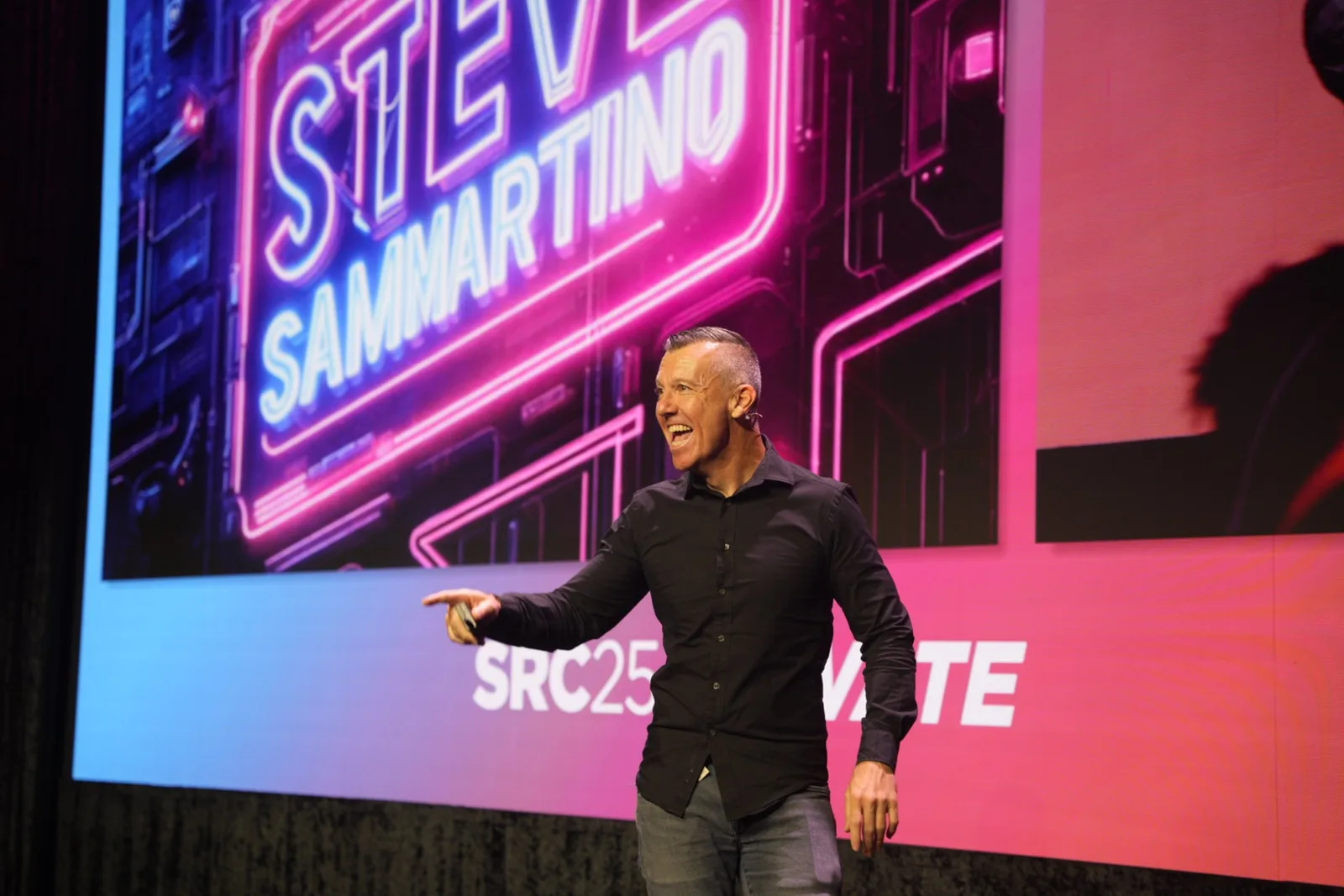
STEVE Sammartino is known as a Futurist: an expert on trends, business opportunities, artificial intelligence, robotics, and other high technology.
But his stock-in-trade is comparatively low-tech. It’s human speech.
The man can talk the leg off a chair, and he’s made a career of it.
By his count, over 700 keynote speeches in 41 countries. A prolific writer, too: two books, another on the way, and over three million words on his Substack blog.
Ahead of his keynote address at next month’s What’s Next? event in Sydney, Australian Conveyancer caught up with Steve between flights, in a video chat from Adelaide airport.
Steve paused - but only momentarily - when we asked what a Futurist is.
“The Futurist title is one that was given to me,” he mused. “People just kept saying that’s what I am.
“But really, I’m a Technology Economist. What I try to do is have a look at plausible trajectories’ and then help people have a plan for when they arrive.”
In other words, helping individuals, companies and government evolve and adapt to rapid change.
It’s less about predicting the future than using it.
As Steve says, quoting American science fiction author William Gibson, “The future is already here. It’s just not evenly distributed.”
Examples include wearable tech, virtual reality, robotics, and of course, AI.
“It’s showing people what their future can be, if they embrace this technology,” he explains. “To say, here’s this tool: use it.”
People, companies and government can be suspicious, slow to adopt. He understands the caution.
“They act slow because, as a species, we must be careful to keep ourselves alive.
“That’s deep in our DNA. New tech can’t just be awesome; it must be socially acceptable as well.”
He doesn’t subscribe to the “jobs apocalypse,” the fear that AI and robots will inevitably steal our jobs and livelihoods.
Or the backlash against energy-hungry data centres. “They’re like trucks,” Steve says. “People might not like them, but they like the things they deliver.”
As for professions like conveyancing, he believes AI will do the grunt work but not replace the practitioner.
“I think our jobs are going to be about managing AI agents, managing the process and managing people rather than doing the physical tasks,” he said.
“That way we do more, we can spend more time with our clients. But we’ve got to oversee the work.”
Steve was an early adopter. Growing up on a Victorian farm, he used computers to overcome isolation, writing code at age 10.
“I was pretty big on computers in the early 80s, then sort of dropped it for nearly 10 years.”
He studied economics at university, worked in marketing and advertising, launched and sold a sharing startup called Rentoid.com.
“The future is already here. It’s just not evenly distributed.”
With that experience, colleagues would ask him to explain the digital world to their workplace teams.
“Then one day a guy in the audience said, ‘you do keynotes, have you got an agent? You should be doing this for a career.’
“That was 12 years ago, and I’ve never really looked back.”
Ironically for a technologist, he supports limits on children’s access to social media.
“They should be banned until they’re 18,” he said, “Go ask anyone in Silicon Valley whether they give their kids a smart phone and the answer is always no. It’s not good for brain development.
“But the tools are incredibly powerful, and just like driving a car or drinking alcohol, there are certain things that need to be age gated.”
AC’s airport interview ended when a glitch froze our video chat. As Steve said, “New tech can do a lot of things, but it’s not perfect.”
THE SECRET SAUCE
Steve says he helps people and organisations navigate the inevitable future: making sense of emerging technology and exploring its possibilities.
To that end, he considers three factors:
1. Anthropology: human behaviour. Steve often jokes that humans run on software: their DNA, and it’s important to understand what’s going to be socially acceptable.
2. Technology: the tools humans use to do things. Those tools are always evolving, and now they’re changing quicker than ever. “If the cost to switch to a better option is lower,” he says, “people will move to it.”
3. Economics: how we trade. Will new technology facilitate the way people behave and provide a big enough incentive to move to a new way of getting things done? If so, it will change the way things, money and people move around.
“This is my secret template,” Steve says. “It enables me to blow minds on the stage doing keynote speeches and to provide future proof strategy for any company, in any industry.”
Steve Sammartino will be the keynote speaker at Australian Conveyancer’s ‘What’s Next’ expo at Sydney W Hotel on November 17, bringing his unmatched ability to make sense of how emerging technology applies to our industry.
https://www.australianconveyancer.com.au/events/whats-next-2026/
In this story