
Debt concerns: treasurer’s era of cheap-money ending
Borrowing money is getting more expensive, but AI "hyper-scalers" competing for your cash are not necessarily to blame, according to economists.
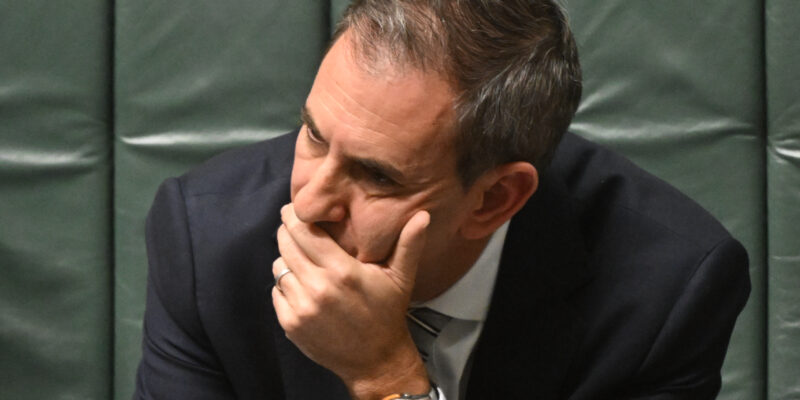
BECAUSE everyone wants your money, you can charge them more for it.
That’s the issue facing governments forced to pay investors more for borrowing cash in the form of bonds.
The eye-watering sums being raised by artificial intelligence “hyper-scalers” now mean there’s a flood of higher-yield bonds jostling with the Treasury for buyers, forcing the government to price its debt higher.
“There’s huge competition from the hyper-scalers for capital, and you’ve got all of the uncertainty … around the energy transformation and AI,” Treasurer Jim Chalmers told reporters in Canberra on Monday.
That assessment came as Dr Chalmers took a victory lap, as the final budget outcome for 2025/26 showed the government’s balance sheet was $6 billion stronger than forecast in May.
The price of the government’s debt was a sore point in the fiscal report card, coming in at $27.7 billion – $87 million more than forecast.
But that is predicted to grow a whopping 8.8 per cent a year to $46.9 billion in the 12 months to mid-2030.
The cost of government debt has also consistently exceeded Labor’s estimates since before hyper-scalers came onto the scene.
Having tipped 10-year bonds to return 4.8 per cent a year in May’s budget, that figure now sits at a 15-year high of 5.4 per cent.
It’s more than double what Canberra thought borrowing would cost in 2022.
The numbers showed the world was in the twilight of an era where money was unusually cheap, NAB market strategy head Skye Masters told AAP.
“We’re going back to the pre-GFC (2008 global financial crisis) period,” she said.
“The geopolitical risks, the on shoring, the demographics, the digitalisation, the inflation, all these things that mean that cash rates … are probably going to be slightly higher than we’re used to.”
More expensive money was simply something to get used to, not panic about, according to Ms Masters.
“Don’t look for yields back down at one per cent, don’t look for cash rates back near zero,” she said.
The treasurer’s jab at hyper-scalers came after Alphabet, Google’s parent company, in August raised $5.5 billion in the largest corporate bond sale in Australian history outside the banking sector.
Amazon is also expected to hop aboard with its own Kangaroo debt issuing later in 2026.
But it was easy to overstate the impact these deals had on Australia’s bond market, which was primarily driven by global factors, Commonwealth Bank market strategy research head Adam Donaldson told AAP.
“The first deal by Alphabet was digested very, very well … we think there’s very good room for further issuance by hyper-scalers,” he said.
“Australia with the AAA (credit) rating and the RBA showing its resolve stands apart from most of the rest of the world in terms of credibility … there’s a strong appetite to invest.”