
Would-be Premier’s sights on housing challenge
Facing her first election as NSW Opposition leader, Kellie Sloane outlines what her government’s priorities will be in terms of property, infrastructure and regional growth.
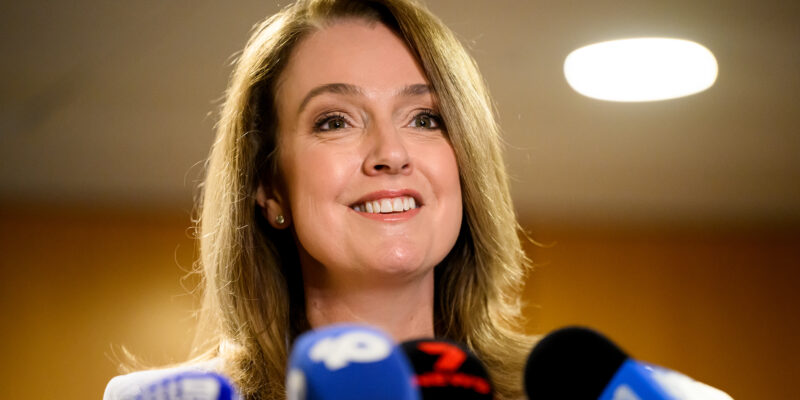
BY her own admission, NSW Opposition Leader Kellie Sloane faces a monumental task.
Elected unopposed as leader of the NSW Liberals last November, she now has just nine months before the next State election.
No first-term NSW Opposition Leader has won an election since the 1930s, and the Coalition needs to claw back a dozen seats to form a majority government.
History is against her. But as 53-year-old Sloane declared after taking over from Mark Speakman, “I’m here to make history.”
Her team, she says, has the right mix of youth and experience to oust Labor Premier Chris Minns.
Almost one-third of the Shadow Cabinet, including Sloane’s deputy Natalie Ward, are women.
“We’re match fit, we’re ready to govern, and we’re highly motivated,” she told Australian Conveyancer’s Face to Face podcast.
“I would argue that NSW has gone backwards in the last three years. We’ve gone from the top-performing state… now we’re right at the bottom of the pack.”
Key issues include the cost of living and housing.
The latter is certainly a priority for the Minns government, but Sloane claims it’s been “a Big Fat Fail.”
“They’ve talked a big game on housing,” she said, “but they haven’t delivered. We’re 40 per cent behind our Housing Accord target.”
That target is 377,000 new homes by mid-2029.
“There have been 44,000 approvals this year,” Sloane said. “In the peak just before COVID, with the Coalition, it was getting close to 80,000.
“There have been a lot of circles on maps where they (Labor) want uplift, without having to invest in infrastructure.”
While city infrastructure might be satisfactory, she says regional housing plans can be frustrated by inadequate roads, water, sewage and power.
“If we were returned to Government, we’d have an infrastructure guarantee outside of Sydney,” Sloane said.
“A quarter of all government spending on infrastructure would be in regional NSW.”
Six days after Face to Face, Sloane again hammered the housing theme in her response to the June 23 NSW Budget.
“This is a bad Budget,” she told reporters shortly after Treasurer Daniel Mookhey’s delivery.
“It is a Budget that lacks vision… in fact, their vision is so bad, they need to go to Specsavers.”
Her vision includes reducing the impact of government fees and red tape on construction costs.
“Almost 50 per cent of the cost of a new home is government taxes and charges,” she told Face to Face. “For a unit it’s about 40 per cent.”
Many developers also decry the NSW Housing Productivity Contribution: in Greater Sydney, about $13,000 per new dwelling lot. Ironically, it’s meant to fund infrastructure.
“We would remove that tax for the Housing Accord period: the next couple of years.” Sloane said.
“After that, the Productivity Contribution would be paid on completion of a dwelling, rather than up front.”
Sloane grew up in country towns including SA’s Tanunda and Port Lincoln.
She attended Nuriootpa High School, and completed a Bachelor of Arts at the University of South Australia.
Her father, Bob Sloane, was mayor of Barossa Council from 2014 to 2018.
“I know how isolated and forgotten you can feel,” she said. “For the ageing, it’s so much harder to get to doctor’s appointments.”
She’s keen to encourage more professionals to settle in regional centres, especially health workers.
Sloane concedes the NSW government is trying to tackle the housing crisis.
As Premier Minns said back in April, “We genuinely believe we’ve still got Everest to climb. But we like to think we’re at Base Camp.”
“Credit where it’s due,” Sloane told Face to Face. “There’ve been some important reforms the government has tried to progress.
“We’ve sat at the table and worked with them on that. We want this to be a success; we don’t want this to be a political issue. We want housing to cross all party divides.”
But – for example – she disagrees with the Government’s reluctance to commit to further Sydney Metro lines, which would drive more housing.
They are staggeringly expensive. The 24km, 9-station Metro West line from the city to Parramatta will cost at least $30 billion and won’t open before 2032.
However, Sloane says given the long construction time, they should be on the drawing board.
Now, the Government is only funding business cases to identify future extensions.
“You need to plan for the future,” she said. “By saying a hard ‘no’ now, you’re depriving the next generation of young people of those important transport connections.”
In her Budget Reply speech, she promised to “progress” a south-west Sydney Metro extension.
Sloane feels NSW badly needs a revival of economic activity and confidence.
She says 6,200 NSW businesses have failed in the past year, many in the building sector.
“Something is going terribly wrong,” she adds. “For all the talk, there’s been very little delivery from Labor.”
Among the complaints heard from employers is the payroll tax. In NSW it’s 5.45 per cent on wages that exceed a $1.2 million threshold.
“It’s fixed,” she said. “So as wages have grown, businesses have gone backwards. That’s something we as Liberals would address.”
They’ve vowed to lift the threshold to $1.5 million and cut the tax to 4.75 per cent for businesses with a total payroll below $10 million.
She also says new Labor legislation gives unions access to a company’s digital systems, which can include HR files, payroll systems, and internal emails, “to reward their union mates.”
“This is unprecedented access that you don’t have in any other State,” Sloane added. “It’s undermining business certainty.”
A former TV journalist and charity CEO, Sloane is pragmatic. She doesn’t claim to have a magic wand and admits, “This housing crisis is complex.”
Like Labor, she supports affordable housing for community workers, higher density around transport hubs, adaptive re-use, modular and pre-fab housing.
And she agrees with city lobbyists who want a greater Sydney CBD population.
“It’s a ghost town!” she said. “After working hours, it’s dead. And that’s a real shame.”
Also, a shame, the challenge of high prices, high interest rates and crippling mortgage repayments.
When Sloane bought her first apartment, prices were around three times the average income. Now it’s 11 times.
“A young me today, working just as hard and making as many sacrifices, couldn’t get a shoo-in,” she said.
But, she added, young home-seekers shouldn’t despair.
“Maybe you can’t buy close to your parents. But I would still encourage young people to invest wherever they can.
“Perhaps in a country area, or the outer suburbs. Make a start: property is still a worthwhile investment.”