

AUSTRALIANS still need more than a decade to save for their first house despite property prices falling across the nation.
The average national time to afford a 20 per cent deposit on a median-priced house is 11.9 years, Cotality's quarterly affordability report released on Wednesday reveals.
The figures are slightly lower for apartments, at 8.8 years, but even that is a marginal increase from the June quarter.
The nation's fastest housing downturn in four decades is yet to provide substantial relief for potential buyers, with the cash rate at an 18-year high.
Home buyers have been under pressure after the Reserve Bank implemented five rate hikes during 2026 to curb surging inflation.
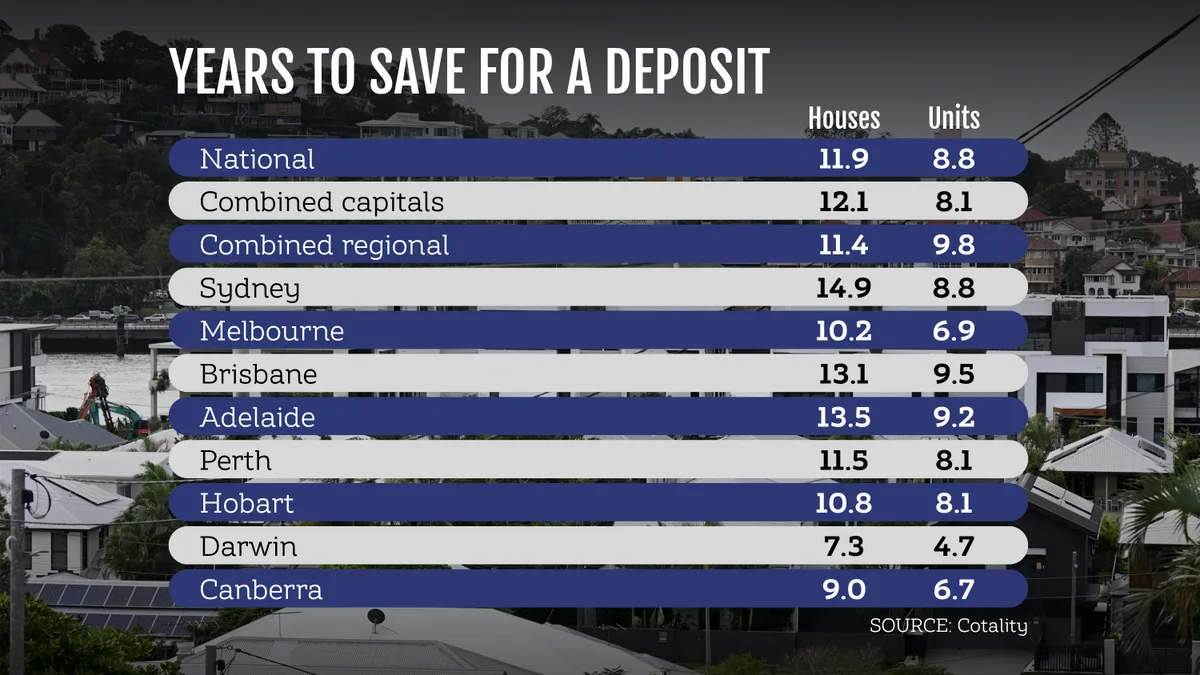
Cotality said that while three of its four affordability measures improved nationally in the September quarter, all remained close to their least-affordable levels on record.
While curbs to investor tax breaks in the May budget have caused house prices to tumble, they are yet to materially improve affordability for first home buyers.
''Buyers are in a stronger position to negotiate on price than they were six months ago, but that hasn't necessarily translated into greater purchasing power," Cotality head of research Gerard Burg said.
"Higher mortgage rates have offset much of the benefit of falling property prices."
The median dwelling cost increased by 33 per cent in the five years to September.
Adelaide overtook Sydney for the first time as the least affordable capital city.
Repayments for a mortgage on the median Adelaide dwelling would absorb about 57 per cent of household income, compared with 55 per cent in Sydney and 54 per cent in Brisbane.
Regional dwelling unaffordability has outpaced that of cities with a 39.6 per cent increase over the last five years.
''Regional housing can still represent good value for someone moving out of a capital city who can retain their existing income, but it's a very different proposition for someone earning a local wage,'' Mr Burg said.
Quote ''Buyers are in a stronger position to negotiate on price than they were six months ago, but that hasn't necessarily translated into greater purchasing power."
The figures come after the annual Rental Affordability Index revealed no Australian cities have rents that cost less than 20 per cent of the median income.
''For renters whose housing costs have risen much faster than their incomes, falling property prices may bring down the deposit they need, but that doesn't necessarily mean they're able to save it any faster,'' Mr Burg said.
A deeper housing downturn could also jeopardise new housing supply in markets where high construction costs and labour shortages were already affecting development feasibility, he said.
In this story