

AUSTRALIA’S biggest business lender has boosted its defences against bad debts as customers adjust to a fifth interest rate rise in nine months, after posting a fall in annual earnings.
National Australia Bank boss Andrew Irvine is warning of tough times ahead for households and businesses, as the Reserve Bank waits for those rises to do their intended job to ease inflation.
But economic growth is already slowing, and the jobless rate is still expected to rise going through 2027 and into 2028, potentially putting pressure on loan repayments.
"We currently expect the Reserve Bank of Australia to keep rates on hold from here, but uncertainty remains high and cost pressures continue to pose a risk to economic growth in the near term," Mr Irvine told a results briefing on Thursday.
"Longer term, Australia has many advantages.
"However, realising our potential requires a sustained focus on productivity to improve living standards and support sustainable economic growth."
"The sooner we get them into watch; the sooner we can work with them to address the cash flow issues ... then hopefully we can actually reduce the transition to delinquency and into impairment."
The bank, which ranks third in size behind Commonwealth Bank and Westpac, revealed it had booked more than $1 billion in charges and increased provisions for bad debts.
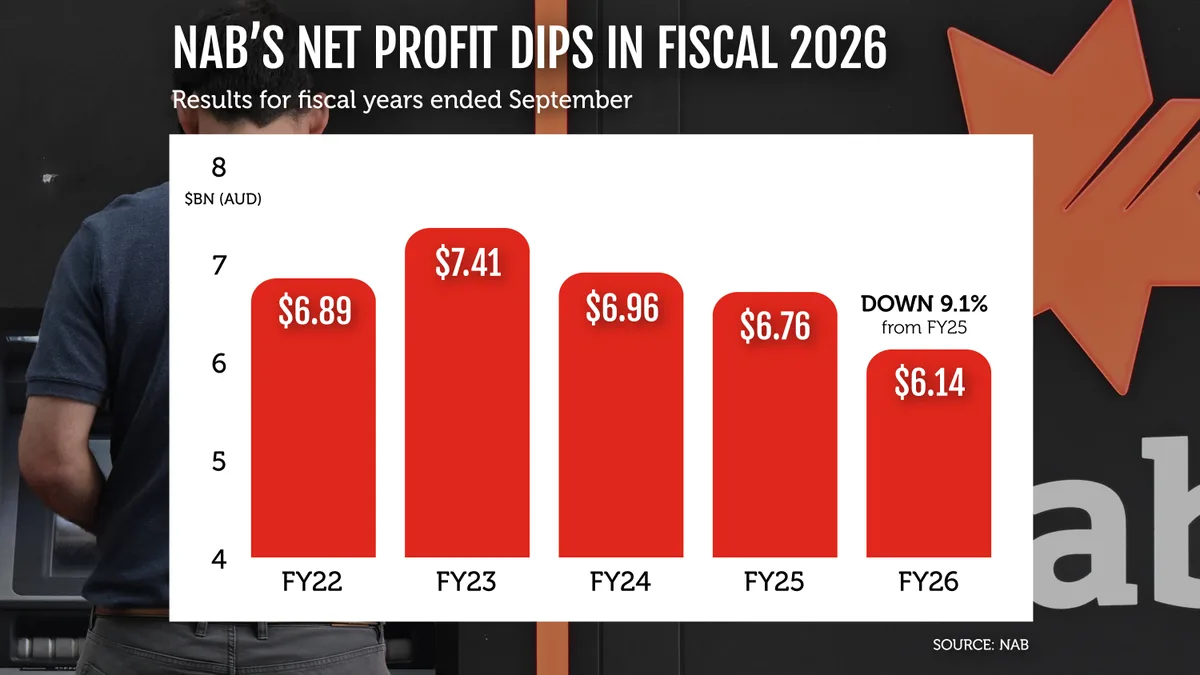
That, along with costs linked to technology upgrades, sent NAB's fiscal 2026 bottom-line net profit down 9.1 per cent to $6.14 billion, and underlying cash earnings down 13.4 per cent.
Its total credit impairment charge, including top-ups to future provisions, was $1.5 billion, up from $833 million in fiscal 2025.
That included individually assessed charges of $1.1 billion linked to customers and collective forward-looking provision charges of $464 million.
Mr Irvine said customers had so far remained resilient and household savings buffers were still high.
"Many of our business customers are seeing opportunities to grow and invest, but despite that resilience ... it's not surprising that an increased number of customers need our support," he added.
NAB has eyes on its customers to catch financial stress early and is already seeing an increase in both "watch loans" and early-stage loan arrears.
"The sooner we get them into watch, the sooner we can work with them to address the cash flow issues ... then hopefully we can actually reduce the transition to delinquency and into impairment," Mr Irvine said.
"I'd say more than 70 per cent of exposures transferred to specialist business restructuring teams tend to be remediated and returned," chief financial officer Inder Singh added.
The bank's shares dropped more than six per cent to $38.45 in afternoon trading.
Of all the major banks, NAB has the strongest focus on small-to-medium businesses - alongside its traditional retail banking, private banking and institutional finance arms - which drives about 75 per cent of underlying earnings.
While NAB's asset quality was sound, rising mortgage arrears and stress in parts of its business lending business could lead to higher credit costs, Moody's Ratings analyst Daniel Yu said.
"NAB's FY26 results highlight some of the challenges facing Australian banks as economic conditions weaken," he added.
In October, NAB announced job cuts totalling 2500, or six per cent of its workforce, as part of a bigger plan to make its operations more efficient.
"I would expect that we will deliver productivity in 2027 that will be more than we have ever done as a bank," Mr Irvine said.
"Part of that will be from workforce adjustment ... and part of that will be driven by ... simplification and modernisation."
NAB had planned to shed 1500 jobs by Christmas, which would have meant those workers missed out on a pay rise due in January, according to the Finance Sector Union.
The timeline has now been extended to the end of that month.
NAB declared a final dividend of 85 cents, taking the total payout to investors for the year to $1.70 per share, unchanged from fiscal 2025.
In this story