

AUSTRALIA’S biggest business bank has suffered a fall in annual profit after booking more than $1 billion in charges related to loan repayments.
National Australia Bank reported a statutory net profit of $6.14 billion, down 9.1 per cent, as cash earnings dropped by 13.4 per cent for the 2026 fiscal year.
"In FY2026 we delivered good momentum while taking deliberate steps to strengthen our resilience, positioning us to continue growing and supporting customers," chief executive Andrew Irvine said on Thursday.
§ Higher credit impairment charges
The bank recorded higher credit impairment charges, including top-ups to future provisions "given more challenging economic conditions".
The charge for the year ended September 30 came to $1.5 billion, up from $833 million in fiscal 2025.
The 2026 charge included individually assessed charges of $1.1 billion linked to customers and collective forward-looking provision charges of $464 million.
"We have strengthened provisioning to reflect a more challenging environment of slowing growth, declining house prices, higher interest rates and inflationary pressures," the bank said.
The bank boss noted NAB's underlying profit would have risen by 6.9 per cent over the year if large items were deducted and its cash earnings would have been flat at $7.1 billion.
§ Slowing economy and housing market risks
But Australia's economy was slowing, the bank warned, after five central bank interest rate hikes since February.
"Cost pressures continue to pose a material risk to the economy, while the correction in the housing market poses some additional downside risk to growth," it said.
"For both growth and inflation, productivity remains a key challenge."
§ Business lending and deposits grow
Of all the major banks, NAB has the strongest focus on small-to-medium businesses, alongside its traditional retail banking, private banking and institutional finance arms.
During the year, its Australian business lending balance rose by 9.8 per cent after it gained more market share.
At the same time, total deposits rose 5.2 per cent, including a solid 7.4 per cent gain in business transaction account balances.
§ Job cuts and an unchanged annual dividend
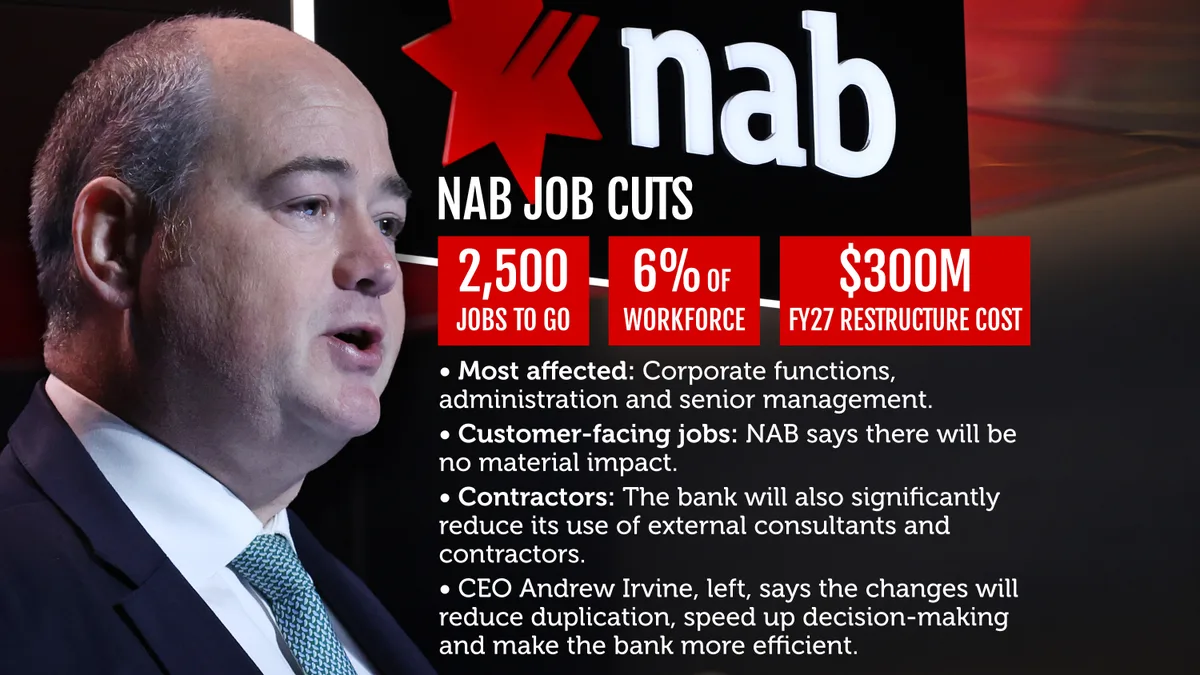
In October, NAB announced sweeping job cuts, putting 2500 roles on the chopping block as part of a plan to "simplify" its operating model.
The cuts will result in restructuring costs of about $300 million in 2027.
"These changes, along with the ongoing disciplined execution of our strategy, position NAB to navigate the near-term uncertainty," Mr Irvine said.
NAB declared a final dividend of 85 cents, taking the total payout to investors for the year to $1.70 per share, which was unchanged from 2025.
Frequently asked questions
Why did NAB strengthen its provisioning?
How would NAB's results look without large items?
What dividend did NAB declare?
In this story